High-Yield Savings Accounts in 2026: What to Look For
Published April 2026 · 9 min read
This article is for informational purposes only and does not constitute financial advice. See our full disclaimer.
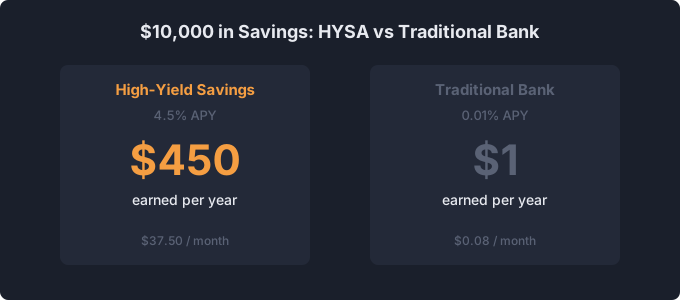
If your savings are sitting in a traditional bank account earning 0.01% APY, you are leaving hundreds of dollars on the table every year. A high-yield savings account (HYSA) paying 4% to 5% APY earns you $400 to $500 per year on a $10,000 balance — compared to roughly $1 at a traditional bank. That is real money for doing nothing more than moving your cash to a different account.
High-yield savings accounts have become one of the simplest financial upgrades available. They are FDIC insured, require no minimum balance at most online banks, charge no monthly fees, and give you the same federal protection as any major bank. The only trade-off is that most are offered by online-only banks, which means no physical branches. For an emergency fund or savings goal, that is rarely a problem.
What Makes a Savings Account "High-Yield"?
A high-yield savings account is simply a savings account that pays a significantly higher interest rate than the national average. In 2026, the national average savings rate is approximately 0.01% APY. Any account paying above 3.5% APY is generally considered high-yield. The top accounts currently offer 4.00% to 5.05% APY, which is 400 to 500 times the national average.
The reason online banks can offer these rates is straightforward: they have dramatically lower overhead costs. No branches to maintain, no tellers to staff, no rent to pay on prime retail locations. Those savings get passed to customers in the form of higher interest rates. The math works out in everyone's favor.
How Much Can You Actually Earn?
The difference between 0.01% and 4.5% APY is enormous when applied to real balances. Here is what you would earn in one year at different balance levels with a 4.5% APY account.
$1,000 balance: $45/year (vs. $0.10 at a traditional bank). $5,000 balance: $225/year (vs. $0.50). $10,000 balance: $450/year (vs. $1.00). $25,000 balance: $1,125/year (vs. $2.50). $50,000 balance: $2,250/year (vs. $5.00).
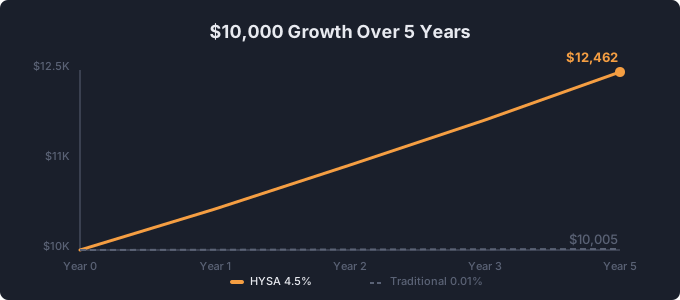
Over 5 years with compound interest, a $10,000 deposit at 4.5% APY grows to approximately $12,462 — without adding a single dollar. Use our compound interest calculator to see exactly how your balance grows over any time period at any rate.
What to Look For in a HYSA
Not all high-yield accounts are created equal. Here are the features that matter most when choosing one.
APY and Rate Stability
The advertised APY is the most obvious factor, but rate stability matters too. Some banks offer teaser rates that drop after a few months. Look for banks with a consistent track record of competitive rates over the past 12 to 24 months, not just the highest rate today. A bank offering 4.3% consistently is often better than one offering 5.0% that drops to 3.5% after your first quarter.
No Monthly Fees and No Minimums
The best high-yield savings accounts charge $0 in monthly fees and require no minimum balance to earn the full APY. If a bank requires you to maintain $10,000 or charges a $5/month fee, your effective return drops significantly. A $5/month fee on a $5,000 balance wipes out $60/year — eating into more than a quarter of your interest earnings.
FDIC or NCUA Insurance
This is non-negotiable. Your deposits must be insured by the FDIC (for banks) or NCUA (for credit unions) up to $250,000 per depositor, per institution. This means your money is protected even if the bank fails. Verify insurance status directly on the FDIC or NCUA website — do not rely solely on the bank's own claims.
Easy Transfers and Access
You should be able to link your HYSA to your primary checking account and transfer money in 1 to 2 business days. Some online banks now offer same-day or instant transfers for linked accounts. Check whether the bank supports ACH transfers, wire transfers, and mobile check deposit. The easier it is to move money in and out, the more useful the account is for emergency savings.
Online Banks vs. Traditional Banks
The rate gap between online and traditional banks has never been wider. Traditional brick-and-mortar banks pay an average of 0.01% to 0.05% APY on savings accounts. Online banks pay 4.00% to 5.05% APY. The difference on a $10,000 balance is roughly $440 to $500 per year — essentially free money you are giving up by staying at a traditional bank.
The main advantage of traditional banks is the ability to walk into a branch. But for a savings account — which you deposit into and rarely withdraw from — branch access is largely irrelevant. You can keep your checking account at a traditional bank for day-to-day needs and open a HYSA at an online bank specifically for savings. This is actually the recommended setup because the slight friction of transferring between banks helps prevent impulsive withdrawals from your savings.
When a CD or Money Market Account Might Be Better
A HYSA is the right choice for most people in most situations, but there are scenarios where alternatives make sense.
Certificates of Deposit (CDs) lock your money for a fixed term (3 months to 5 years) in exchange for a guaranteed rate. In 2026, top CD rates range from 4.25% to 4.75% APY depending on the term. CDs make sense if you want to lock in today's rate and do not need the money during the term. The downside: early withdrawal penalties typically cost you 3 to 6 months of interest. Do not put emergency fund money in a CD.
Money market accounts function similarly to high-yield savings accounts but sometimes offer check-writing ability and debit card access. Rates are comparable — typically 3.75% to 4.50% APY in 2026. They can be useful if you want slightly more access to your savings without the 1-2 day transfer delay of a standard HYSA.
Common HYSA Myths Debunked
Myth: Online Banks Are Not Safe
Online banks with FDIC insurance are exactly as safe as traditional banks. Your deposits are protected up to $250,000 regardless of whether the bank has physical branches. The FDIC has never failed to protect an insured deposit in its history.
Myth: High Rates Will Not Last
HYSA rates do fluctuate with the federal funds rate, but online banks have consistently paid 10 to 50 times the national average for over a decade. Even if rates drop from 4.5% to 3%, that is still 300 times what a traditional bank pays. The relative advantage of a HYSA persists in all interest rate environments.
Myth: You Need a Lot of Money to Open One
Most top high-yield savings accounts have $0 minimum deposit requirements. You can open an account with $1 and start earning the full advertised APY immediately. There is no reason to wait until you have a large balance — every dollar you deposit starts earning interest from day one.
Myth: Interest on Savings Is Not Worth the Effort
Opening a HYSA takes about 10 minutes. Setting up a recurring transfer takes another 5 minutes. For 15 minutes of effort, you earn an extra $400 to $500 per year on a $10,000 balance — and that compounds annually. Over 10 years, the difference between 0.01% and 4.5% on $10,000 is more than $5,500. That is not trivial.
See how your savings grow over time
Enter your balance, rate, and monthly contributions to see the power of compound interest.
Open Compound Interest Calculator →Related tools
Compound Interest Calculator — See how your HYSA balance grows over time
Savings Goal Calculator — Set a savings target and track your progress
Subscription Tracker — Cut recurring costs and redirect to savings
Related guides
How to Build an Emergency Fund — Where a HYSA fits in your financial plan
Saving for a House Down Payment — Where to park your down payment fund