Saving for a House Down Payment: A Step-by-Step Guide
Published April 2026 · 10 min read
This article is for informational purposes only and does not constitute financial advice. See our full disclaimer.
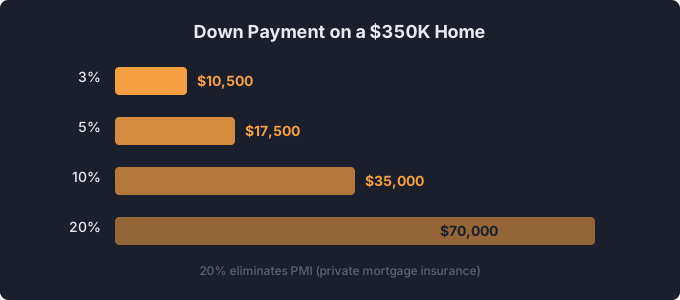
Buying a home is the largest financial commitment most people will ever make, and the down payment is the biggest hurdle standing between you and the keys. On a $350,000 home — close to the national median in 2026 — you need anywhere from $10,500 (3% down with an FHA loan) to $70,000 (20% down for a conventional loan). Add closing costs of 2% to 5%, and the total cash needed at closing ranges from $17,500 to $87,500.
Those numbers are daunting, but they are achievable with a clear plan, the right savings strategy, and enough time. This guide breaks down exactly how much you need, where to keep the money while you save, and practical strategies to reach your target faster.
How Much Do You Actually Need?
The amount you need depends on the type of mortgage you qualify for and the purchase price of the home. Here is a breakdown for a $350,000 home.
FHA Loan: 3.5% Down
Federal Housing Administration loans require just 3.5% down with a credit score of 580 or higher. On a $350,000 home, that is $12,250. The trade-off: you will pay mortgage insurance premiums (MIP) for the life of the loan — an upfront premium of 1.75% ($6,125) plus annual premiums of 0.55% ($1,925/year, or about $160/month added to your payment).
Conventional Loan: 3% to 20% Down
Conventional loans allow as little as 3% down ($10,500) for first-time buyers through programs like Fannie Mae's HomeReady. However, anything less than 20% down requires private mortgage insurance (PMI), which typically costs $100 to $250/month on a $350,000 home. At 20% down ($70,000), you avoid PMI entirely, which saves $1,200 to $3,000 per year.
Do Not Forget Closing Costs
Closing costs are the expense most first-time buyers underestimate. They typically run 2% to 5% of the purchase price — that is $7,000 to $17,500 on a $350,000 home. These cover lender fees, appraisal, title insurance, escrow, recording fees, and prepaid property taxes and insurance. You can sometimes negotiate for the seller to cover a portion, but plan to have this cash available.
Your total savings target: down payment + closing costs + a cash reserve of at least 2 months of mortgage payments. For a 10% down conventional loan on a $350,000 home, that means roughly $35,000 (down payment) + $10,000 (closing costs) + $5,000 (reserves) = $50,000 total. Use our savings goal calculator to map out your timeline based on how much you can save each month.
Where to Park Your Down Payment Fund
Since you will need this money within 1 to 5 years, you need an account that is safe, liquid, and earns a reasonable return. Do not invest your down payment in stocks — a 20% market drop right before you need the money could delay your purchase by years.
The best options in 2026 are high-yield savings accounts paying 4% to 5% APY. On a $40,000 balance, that earns you $1,600 to $2,000 per year in interest. If your timeline is 2+ years and you will not need the money sooner, a CD ladder (splitting your savings across CDs with staggered maturity dates) can lock in rates and potentially earn slightly more. See our HYSA guide for what to look for in an account.
Building Your Savings Timeline
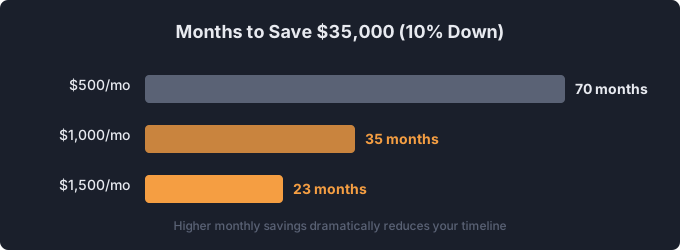
Your timeline depends on your target amount and monthly savings rate. Here is how long it takes to save $50,000 (10% down + closing costs + reserves on a $350,000 home) at different monthly contribution levels.
$500/month: 8 years, 4 months. $750/month: 5 years, 7 months. $1,000/month: 4 years, 2 months. $1,500/month: 2 years, 10 months. $2,000/month: 2 years, 1 month.
These timelines include interest earned at 4.5% APY. The compound interest shaves months off your timeline — on a $1,000/month savings plan, you earn roughly $4,700 in interest over the savings period. That is almost 5 extra months of contributions that you do not have to make.
7 Strategies to Save Faster
1. Automate a Dedicated Savings Transfer
Open a separate high-yield savings account labeled specifically for your down payment. Set up an automatic transfer on every payday. When the money moves before you see it in your checking account, you are far less likely to spend it. Start with whatever amount you can commit to and increase it by $50 every quarter.
2. Reduce Your Subscription Spending
The average American spends $84/month on subscriptions — over $1,000/year. Run a quick audit using our subscription tracker and cancel services you do not actively use. Redirecting just $50/month in subscription savings adds $600/year to your down payment fund, or roughly $3,000 over 5 years with interest.
3. Generate Side Income
Even modest side income accelerates your timeline dramatically. Freelancing, tutoring, selling unused items, or picking up weekend work at $200 to $500/month can cut years off your savings plan. The key is to deposit 100% of side income directly into your down payment account — treat it as money that was never yours to spend.
4. Maximize Your Employer Match
This is not directly related to your down payment, but if you are not getting your full employer 401(k) match, you are leaving free money on the table. Contribute enough to get the match (typically 3% to 6% of salary), then direct additional savings capacity toward your down payment fund. Do not sacrifice the match — it is an immediate 50% to 100% return.
5. Use Windfalls Strategically
Tax refunds, bonuses, cash gifts, and inheritance should go directly into your down payment fund. The average tax refund in 2026 is approximately $3,100. Three years of depositing your full tax refund adds $9,300 plus interest to your down payment savings.
6. Reduce Your Largest Expenses
Housing and transportation typically consume 50% to 60% of income. Consider getting a roommate ($400 to $800/month savings), downsizing your car or going to one car ($300 to $600/month savings), or moving to a lower-cost rental temporarily. Aggressive short-term sacrifices can cut your savings timeline in half.
7. Look Into Down Payment Assistance Programs
Many states and cities offer down payment assistance (DPA) grants or forgivable loans for first-time buyers. These programs can provide $5,000 to $25,000 toward your down payment, significantly reducing how much you need to save on your own. Check with your state housing finance agency — eligibility is often broader than people expect.
When Renting Makes More Sense
Buying is not always the right financial move. Renting may be better if you plan to stay in the area for fewer than 5 years (transaction costs eat into any equity gained), if your debt-to-income ratio is above 40%, if you have no emergency fund yet (do not drain your safety net for a down payment), or if local rent is significantly cheaper than the equivalent mortgage payment plus property taxes, insurance, and maintenance.
Run the numbers honestly. A $350,000 home with a 30-year mortgage at 6.5% costs roughly $2,650/month in principal and interest alone — add property taxes ($350/month), insurance ($150/month), and maintenance ($290/month), and the true monthly cost is closer to $3,440. If you can rent a comparable place for $1,800/month and invest the $1,640 difference, renting may build more wealth over a shorter timeframe.
Map out your down payment timeline
Enter your target amount and monthly savings to see exactly when you will reach your goal.
Open Savings Goal Calculator →Related tools
Savings Goal Calculator — Calculate your down payment savings timeline
Compound Interest Calculator — See how interest accelerates your savings
Subscription Tracker — Find subscriptions to cut and redirect to your down payment
Related guides
High-Yield Savings Accounts in 2026 — Where to park your down payment fund
How to Automate Your Savings — Set up hands-free contributions