How to Automate Your Savings
Published April 2026 · 8 min read
This article is for informational purposes only and does not constitute financial advice. See our full disclaimer.
The biggest obstacle to saving money is not income — it is behavior. People who earn enough to save often do not, because saving requires a conscious decision every single time. Automation removes that decision entirely. When money moves to savings before you see it in your checking account, you adjust your spending to what remains — and research shows you barely notice the difference.
Studies on automatic enrollment in retirement plans demonstrate this clearly: when employees are auto-enrolled in a 401(k), participation rates jump from around 40% to over 90%. The same principle applies to personal savings. If the transfer happens without your involvement, it happens consistently. If it requires you to manually move money each month, it happens sporadically at best.
Why Automation Works: The Willpower Problem
Every financial decision you make throughout the day drains a limited supply of mental energy. By the time you sit down to transfer money into savings, you have already made hundreds of small decisions — what to eat, what to buy, whether to grab coffee. This is known as decision fatigue, and it is the reason most people intend to save more than they actually do.
Automation bypasses willpower completely. The money moves on a schedule you set once, regardless of how tired, stressed, or tempted you are on any given day. You cannot spend what you never see in your checking account. This single change — making savings the default rather than an active choice — is the most reliable predictor of long-term savings success.
Method 1: Direct Deposit Splitting
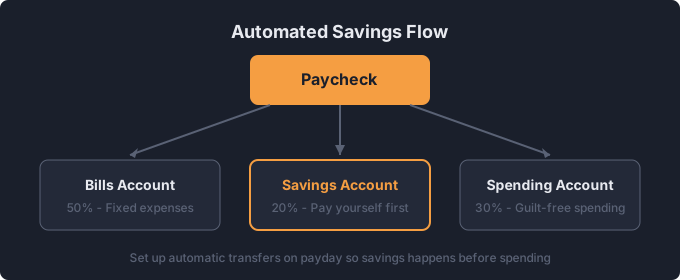
The most effective automation method is splitting your paycheck at the source. Most employers allow you to direct deposit into multiple accounts. Instead of sending your entire paycheck to checking, you split it: a fixed dollar amount or percentage goes directly to a savings account, and the rest goes to checking for bills and spending.
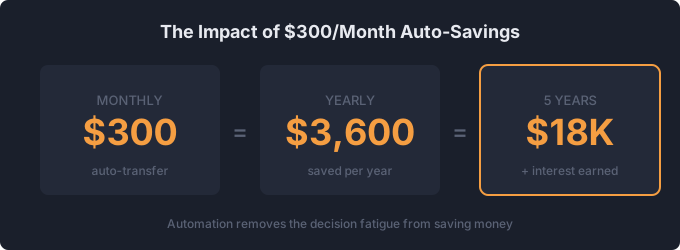
How to set it up: Contact your HR department or payroll provider and request a direct deposit split. You will need the routing number and account number for your savings account. Specify either a flat dollar amount (e.g., $300 per paycheck) or a percentage (e.g., 15%). Most payroll systems process this within one to two pay cycles.
The advantage of direct deposit splitting is that the money never touches your checking account. You never see it, you never have the chance to spend it, and your budget naturally adjusts to the lower checking balance. Start with an amount that feels comfortable — even $50 per paycheck — and increase it by $25 every few months as you adjust.
Method 2: Recurring Auto-Transfers on Payday
If your employer does not support direct deposit splitting, or if you want more control, set up a recurring automatic transfer through your bank. Schedule the transfer for the same day your paycheck arrives — this is the digital equivalent of paying yourself first.
How to set it up: Log into your bank's online portal or app. Navigate to transfers and select "recurring" or "scheduled." Set the amount, choose your savings account as the destination, select the frequency (every two weeks or monthly to match your pay schedule), and set the start date to your next payday.
The key is timing. If the transfer happens on payday, it functions identically to a direct deposit split. If you schedule it for a few days later, you risk seeing the full balance and spending more than intended. Same-day transfers maintain the out-of-sight, out-of-mind effect that makes automation so powerful.
Method 3: Round-Up Savings Tools
Round-up tools automatically save the spare change from every purchase. When you buy a coffee for $4.35, the tool rounds up to $5.00 and transfers the $0.65 difference to savings. Individually, these amounts are tiny. Collectively, they add up to $30–$50 per month for most people without any noticeable impact on spending.
Several banks now offer built-in round-up features, and standalone apps like Acorns and Qapital provide the same functionality with additional options like multipliers (rounding up to the nearest $2 or $5 instead of $1). Round-up savings work best as a supplement to larger automated transfers, not as your primary savings strategy. Think of them as bonus savings that accumulate in the background.
The Pay Yourself First Rule
Every savings strategy in this guide is built on one principle: pay yourself first. This means treating savings as a non-negotiable expense — like rent or utilities — rather than saving whatever happens to be left over at the end of the month. The math is simple but the psychology is profound.
Most people follow this pattern: Income minus Spending equals Savings. The pay-yourself-first rule flips it: Income minus Savings equals Spending. When savings come off the top, your spending automatically adjusts to fit the remaining amount. When savings come last, there is almost never anything left.
A common starting point is saving 10–15% of gross income. If that feels too aggressive, start with 5% and increase by 1% each quarter. The automation handles the discipline — your only job is choosing the right percentage and letting the system run.
Setting Up Your Savings Automation: Step by Step
Step 1: Open a Dedicated Savings Account
Keep your savings separate from your checking account, ideally at a different bank. This creates a physical and psychological barrier against dipping into savings for everyday spending. High-yield savings accounts currently offer 4–5% APY, which means your automated savings earn meaningful interest while they sit.
Step 2: Calculate Your Savings Amount
Review your income and fixed expenses. Use a budget calculator to determine how much you can realistically save each month. The 50/30/20 rule suggests allocating 20% of after-tax income to savings and debt repayment. If you have no debt, that full 20% can go to savings.
Step 3: Choose Your Automation Method
Direct deposit split is ideal if your employer supports it. Recurring bank transfer is the next best option. Use round-ups as a bonus layer on top of either method. You can combine all three for maximum impact.
Step 4: Set a Specific Savings Goal
Automation without a goal leads to vague progress. Define what you are saving for: an emergency fund (3–6 months of expenses), a down payment, a vacation, or retirement. Use a savings goal calculator to determine exactly how much you need to save monthly to hit your target by your deadline.
Step 5: Start and Forget
Once everything is set up, leave it alone. Check your savings balance monthly to confirm transfers are running, but resist the urge to adjust the amount downward when money feels tight. The entire point of automation is removing yourself from the equation. The system works precisely because you are not involved in each individual transfer.
Tracking Your Progress
While the savings themselves should be automated, tracking progress keeps you motivated. Check your savings balance at the start of each month. Compare it to your goal. Watching the number climb steadily — without any active effort on your part — reinforces the habit and makes you less likely to raid savings for non-emergencies.
One often-overlooked step: make sure you are not undermining your savings by letting subscription creep eat into your checking account. Automated savings work best when your spending is also under control. Use a subscription tracker to identify and eliminate recurring charges you no longer need — every $10/month subscription you cancel is $120/year that can flow into savings instead.
The combination of automated savings and controlled recurring expenses is the foundation of building wealth on any income. Set it up once, review it quarterly, and let the system do what willpower cannot.
Find hidden money for your savings
Track every subscription and recurring charge. Cancel what you do not use and redirect it to savings.
Open Free Subscription Tracker →Related tools
Savings Goal Calculator — Calculate how long to reach your target
Compound Interest Calculator — See how automated savings grow over time
50/30/20 Budget Calculator — Find your ideal savings percentage
Related guides
Savings Goal Guide — Set and reach your savings targets
Compound Interest Explained — Why starting early matters so much