How to Build an Emergency Fund from Scratch
Published April 2026 · 10 min read
This article is for informational purposes only and does not constitute financial advice. See our full disclaimer.
An emergency fund is the single most important piece of your financial foundation. It is the buffer between you and debt when life throws something unexpected your way — a car repair, a medical bill, a job loss, or a broken appliance. Without one, a single unplanned expense can spiral into credit card debt that takes months or years to pay off.
The problem is that most people know they need an emergency fund but have no idea how to actually build one. If you are starting from $0, the goal of saving three to six months of expenses can feel impossibly far away. The good news: you do not need to get there overnight. A structured, step-by-step approach makes it manageable — even on a tight budget.
Why You Need an Emergency Fund
Financial emergencies are not a matter of if — they are a matter of when. Research consistently shows that 63% of Americans cannot cover a $500 emergency expense from savings. When those expenses hit, people turn to credit cards, personal loans, or borrowing from family. A $500 car repair charged to a credit card at 24% APR and paid off at $25/month turns into a $580+ expense that takes nearly two years to clear.
An emergency fund eliminates that cycle entirely. It gives you the ability to absorb financial shocks without going into debt, without dipping into retirement savings, and without the stress that comes from scrambling to find money you do not have. It is not about earning a return — it is about buying yourself peace of mind and financial stability.
How Much Should You Save?
The standard recommendation is 3 to 6 months of essential living expenses. Not 3 to 6 months of income — expenses. There is an important difference. If you earn $4,500/month but your essential bills (rent, utilities, food, insurance, transportation, minimum debt payments) total $3,200/month, your target is $9,600 to $19,200, not $27,000.
Where you land in that range depends on your situation. Aim for 6 months if you are self-employed, work on commission, are the sole earner in your household, or work in an industry with frequent layoffs. Three months is reasonable if you have a stable salaried job, dual household income, or strong job market demand for your skills. Use our savings goal calculator to figure out exactly how long it will take to reach your target based on what you can save each month.
Where to Keep Your Emergency Fund
Your emergency fund needs to be liquid, safe, and separate from your everyday checking account. The best option in 2026 is a high-yield savings account (HYSA) earning 4% to 5% APY. That means a $10,000 emergency fund earns you $400 to $500 per year in interest — compared to roughly $1 at a traditional bank paying 0.01%.

Do not invest your emergency fund in the stock market. Stocks can drop 20% to 30% in a downturn — exactly the time you are most likely to need emergency cash. Do not lock it in a CD with early withdrawal penalties. Do not keep it in cash at home where it earns nothing and can be lost or stolen. A HYSA at an online bank with FDIC insurance is the right answer for almost everyone.
Keep this account at a different bank than your primary checking account. The slight inconvenience of a 1-2 business day transfer makes it harder to dip into the fund for non-emergencies, which is exactly what you want.
The Step-by-Step Plan: From $0 to Fully Funded
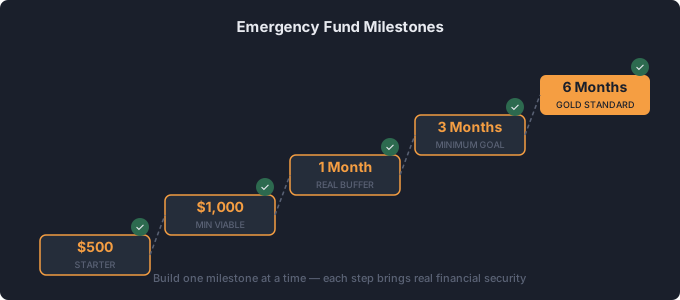
Building an emergency fund is a marathon, not a sprint. Break it into milestone targets so each step feels achievable rather than overwhelming.
Milestone 1: $500 (The Starter Fund)
Your first goal is $500. This covers the most common small emergencies — a car repair, an urgent prescription, or a minor home fix. At $50/week, you reach this in 10 weeks. At $25/week, you are there in 20 weeks. Sell unused items around your house, pick up a few hours of overtime, or redirect one subscription payment. Getting to $500 is a massive psychological win because it proves you can save.
Milestone 2: $1,000
Once you hit $500, push to $1,000. This covers most car repairs, a deductible on many insurance plans, and a month of bare-minimum groceries. At this point, you have a real financial buffer. Many personal finance experts consider $1,000 the minimum viable emergency fund.
Milestone 3: 1 Month of Expenses
Now aim for one full month of essential expenses. If your monthly essentials total $3,200, that is your target. This is the point where your emergency fund goes from handling small surprises to providing genuine security. If you lose your job, you have a full month to find new income before any bills go unpaid.
Milestone 4: 3 Months of Expenses
Three months is the minimum recommended cushion. With $9,600 saved (based on $3,200/month expenses), you can weather a job loss, a medical event, or a major home repair without financial panic. This is the target for people with stable dual incomes or high job security.
Milestone 5: 6 Months of Expenses
Six months — roughly $19,200 at $3,200/month expenses — is the gold standard. At this level, you have a fortress against nearly any financial emergency. Self-employed workers, single-income households, and anyone in a volatile industry should aim here.
Cutting Expenses to Fund Your Savings
If your budget is tight, the money has to come from somewhere. Start with the easiest cuts. Subscription audits are the fastest win — the average American spends $84/month on subscriptions, and most people have at least one or two they have forgotten about or rarely use. Use our subscription tracker to list every recurring charge and cut the ones that do not deliver real value.
Beyond subscriptions, look at dining out ($200–$400/month for many households), unused gym memberships ($30–$60/month), premium app tiers you could downgrade, and impulse purchases. Redirect those savings directly into your emergency fund via automatic transfer. Even $100/month adds up to $1,200 in a year.
Automate Your Contributions
The most important rule of building an emergency fund is this: automate it. Set up a recurring transfer from your checking account to your HYSA on the day you get paid — before you have a chance to spend that money on anything else. Even $25 per paycheck adds up to $650 per year. Increase the amount by $10 every time you get a raise, pay off a debt, or eliminate a subscription.
Many employers also allow you to split your direct deposit across multiple accounts. Allocate a fixed amount — say $100 per paycheck — directly into your emergency fund so the money never even hits your checking account. What you do not see, you do not spend. Use our compound interest calculator to see how your HYSA balance grows over time with regular contributions.
When to Use Your Emergency Fund (and When Not To)
An emergency fund is for genuine emergencies only. That means unexpected, necessary, and urgent expenses. A car breakdown that prevents you from getting to work qualifies. A vacation does not. A medical bill qualifies. A new TV does not. A job loss qualifies. A friend's wedding does not.
If you have to ask whether something is an emergency, it probably is not. Create a separate savings account for planned irregular expenses — holiday gifts, annual insurance premiums, car maintenance, and travel. These are predictable costs, not emergencies, and should have their own dedicated savings.
When you do use your emergency fund, replenish it immediately. Make rebuilding the fund your top financial priority until it is back to your target level. Treat the repayment to yourself with the same urgency you would treat a debt payment to a creditor.
Calculate your savings timeline
See exactly how long it will take to reach your emergency fund goal based on your monthly contributions.
Open Savings Goal Calculator →Related tools
Savings Goal Calculator — Set a target and see how long it takes to get there
Compound Interest Calculator — See how your HYSA balance grows over time
Subscription Tracker — Find recurring charges to cut and redirect to savings
Related guides
High-Yield Savings Accounts in 2026 — Where to park your emergency fund
How to Automate Your Savings — Set it and forget it