Understanding Your Credit Score: What It Is and How to Improve It
Published April 2026 · 11 min read
This article is for informational purposes only and does not constitute financial advice. See our full disclaimer.
Your credit score is a three-digit number that affects nearly every major financial decision in your life — the interest rate on your mortgage, whether you qualify for a car loan, your credit card limits, and even whether a landlord approves your rental application. Despite its importance, most people do not fully understand how credit scores work or what they can do to improve theirs.
The most widely used scoring model is the FICO score, which ranges from 300 to 850. About 90% of top lenders use FICO scores to make lending decisions. This guide breaks down exactly what goes into that number, what the ranges mean, and how to raise your score with concrete, actionable steps.
The 5 FICO Factors That Determine Your Score
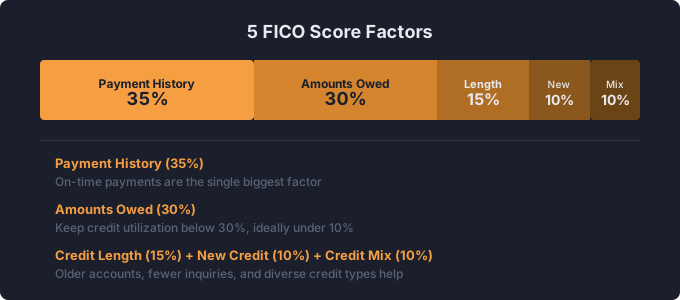
Your FICO score is calculated from five categories, each weighted differently. Understanding these weights tells you exactly where to focus your efforts for the biggest impact.
1. Payment History — 35%
This is the single most important factor. It tracks whether you have paid your bills on time across all credit accounts — credit cards, loans, mortgages, and retail accounts. A single payment that is 30 days late can drop your score by 60 to 110 points, and the damage stays on your report for up to 7 years. Recent late payments hurt more than older ones, and a pattern of late payments is worse than a single incident.
What counts: On-time payments, late payments (30, 60, 90+ days), collections, bankruptcies, and foreclosures. Even a $25 minimum payment made on time counts as a positive mark.
2. Amounts Owed (Credit Utilization) — 30%
This factor looks at how much of your available credit you are using, known as your credit utilization ratio. If you have a $10,000 credit limit and carry a $3,000 balance, your utilization is 30%. Lenders view high utilization as a sign that you are overextended financially.
The general guideline is to keep utilization below 30%, but people with the highest credit scores typically maintain utilization under 10%. This factor is calculated both per-card and across all cards combined. A single maxed-out card hurts even if your overall utilization is low.
3. Length of Credit History — 15%
This measures the average age of all your credit accounts, the age of your oldest account, and the age of your newest account. A longer credit history generally means a higher score because it gives lenders more data to assess your reliability. The average age of accounts for people with scores above 800 is approximately 11 years.
4. New Credit — 10%
Each time you apply for credit, the lender performs a "hard inquiry" on your report. A single hard inquiry typically lowers your score by 5 to 10 points and stays on your report for 2 years. Multiple applications in a short period suggest financial distress and can compound the damage. Rate shopping for a mortgage or auto loan within a 14 to 45 day window counts as a single inquiry.
5. Credit Mix — 10%
Lenders like to see that you can manage different types of credit responsibly. A healthy mix might include a credit card (revolving credit), a car loan (installment credit), and a mortgage. You do not need one of each, but having only one type of credit account can limit your score. This is the least important factor — never take on debt just to improve your credit mix.
Credit Score Ranges: What Is "Good"?
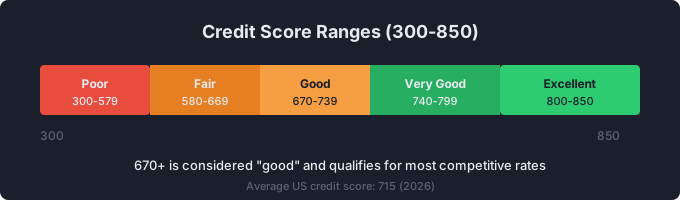
FICO scores fall into five general categories that lenders use to assess risk.
- 800–850 (Exceptional): The top tier. You qualify for the best rates on everything. About 21% of Americans have scores in this range.
- 740–799 (Very Good): You will qualify for most products at competitive rates. About 25% of Americans fall here.
- 670–739 (Good): Considered acceptable by most lenders. You will qualify for most loans but may not get the absolute best rates. About 21% of Americans are in this range.
- 580–669 (Fair): Subprime territory. You can still get approved for many products, but at higher interest rates. About 17% of Americans fall here.
- 300–579 (Poor): Approval is difficult, and interest rates will be very high if you qualify at all. About 16% of Americans have scores in this range.
The difference between a "good" and "exceptional" score is real money. On a $300,000 30-year mortgage, a borrower with a 760 score might get a 6.5% rate ($1,896/month), while a borrower with a 640 score might pay 8.0% ($2,201/month). That is an extra $305/month — or roughly $109,800 over the life of the loan.
How to Check Your Score for Free
You have several free options for monitoring your credit score and reports.
AnnualCreditReport.com is the only federally authorized source for free credit reports from all three bureaus (Equifax, Experian, TransUnion). You can pull your reports weekly at no cost. These show your full credit history but do not include a score number.
Credit Karma provides free VantageScore 3.0 scores from TransUnion and Equifax, updated weekly. While VantageScore is not identical to FICO, it uses similar factors and gives a reliable directional indicator.
Your bank or credit card issuer likely provides a free FICO score on your monthly statement or app. Discover, Capital One, Chase, Bank of America, and many others include this feature for cardholders at no charge.
Important: Checking your own credit score or report is a "soft inquiry" and has absolutely no effect on your score. Check it as often as you want.
7 Actionable Steps to Improve Your Score
1. Set up autopay for every bill. Since payment history is 35% of your score, this is the highest-impact move. Set every credit card and loan to autopay at least the minimum. You can always pay more manually, but autopay ensures you never miss a due date. A single missed payment can undo months of progress.
2. Pay down credit card balances below 30%. If your utilization is above 30%, make it your top priority to bring it down. Pay down the card with the highest utilization first. If you have a $5,000 limit and a $3,500 balance (70% utilization), getting that to $1,500 (30%) could boost your score by 20 to 50 points within one billing cycle.
3. Ask for credit limit increases. This instantly lowers your utilization ratio without requiring you to pay anything down. If you have a $5,000 limit and get it raised to $8,000, your $1,500 balance drops from 30% utilization to 19%. Call your issuer and ask — many will approve increases with no hard inquiry if you have been a good customer.
4. Do not close old credit cards. Closing a card reduces your available credit (raising utilization) and eventually shortens your credit history. Even if you no longer use a card, keep it open and make a small purchase every 6 months to prevent the issuer from closing it for inactivity. The exception: if the card has an annual fee you cannot justify, close it.
5. Become an authorized user. If a family member has a credit card with a long history and low utilization, ask to be added as an authorized user. Their positive account history gets added to your report, which can boost your score — especially helpful if you have a thin credit file. You do not even need to use the card.
6. Dispute errors on your report. Studies show that roughly 1 in 5 consumers have an error on at least one credit report. Pull your reports from AnnualCreditReport.com and look for accounts you do not recognize, incorrect balances, late payments that were actually on time, or duplicate entries. File disputes directly with the bureau — they have 30 days to investigate.
7. Limit hard inquiries. Avoid applying for multiple credit cards or loans within a short period. Space applications at least 3 to 6 months apart. If you are rate shopping for a mortgage or auto loan, do all your applications within a 14-day window so they count as a single inquiry.
Common Credit Score Myths Debunked
Myth: Checking your own score hurts it. False. Checking your own credit is a soft inquiry with zero impact on your score. Lenders pulling your credit when you apply — that is a hard inquiry that can affect your score.
Myth: Closing a credit card improves your score. Usually the opposite. Closing a card reduces your total available credit, which raises your utilization ratio and can lower your score. It also eventually shortens your average account age.
Myth: You need to carry a balance to build credit. Completely false. You can use your card, pay the full statement balance every month, pay zero interest, and still build excellent credit. The bureaus see that you used credit and paid on time — they do not reward you for paying interest.
Myth: Income affects your credit score. Your income is not a factor in FICO scoring. A person earning $30,000 a year can have a higher credit score than someone earning $300,000. What matters is how responsibly you manage whatever credit you have.
How Long Do Improvements Take?
Credit score improvements happen on different timescales depending on the action. Paying down a high credit card balance can boost your score within 30 to 45 days — as soon as the lower balance is reported to the bureaus. Setting up autopay prevents future damage immediately, though the positive impact of a growing on-time payment streak builds gradually over 3 to 6 months.
Recovering from negative marks takes longer. A late payment's impact fades over 1 to 2 years and drops off your report after 7. A bankruptcy stays for 7 to 10 years. The key is that newer positive behavior increasingly outweighs older negative marks — so the sooner you start building good habits, the sooner your score reflects them.
Get your finances organized
Track subscriptions, budget your paycheck, and build a plan to improve your financial health. Free, no signup required.
Open Free Subscription TrackerRelated tools
Debt Payoff Calculator — Paying off debt is the fastest way to improve your score
Net Worth Calculator — See your full financial picture beyond your credit score
50/30/20 Budget Calculator — Budget to stay under 30% utilization
Related guides
How to Get Out of Credit Card Debt — Eliminate high-utilization balances
Debt Snowball vs Avalanche — Choose the right payoff method