How to Get Out of Credit Card Debt
Published April 2026 · 10 min read
This article is for informational purposes only and does not constitute financial advice. See our full disclaimer.
Credit card debt is one of the most expensive forms of consumer debt, and millions of Americans are stuck in it. The average household carries roughly $6,500 in credit card debt at an average interest rate of 24.2% APR. Total U.S. credit card debt crossed $1.14 trillion in early 2026, a record high. If those numbers feel overwhelming, you are not alone — but there is a clear path out.
The good news is that credit card debt is solvable. With the right strategy, consistent payments, and a willingness to cut unnecessary expenses, most people can eliminate their balances in 2 to 4 years instead of the 15+ years that minimum payments would take. This guide walks through every proven method, step by step.
The Minimum Payment Trap
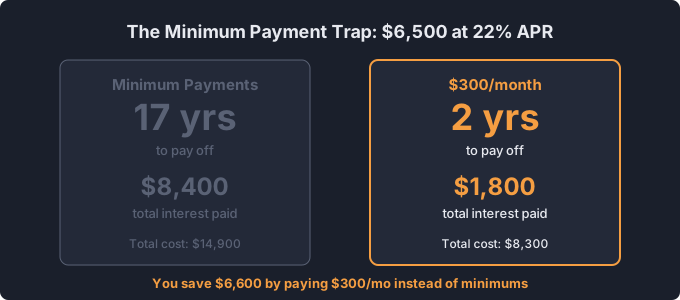
Credit card companies set minimum payments low on purpose — typically 1% to 3% of your balance, or a flat $25, whichever is greater. On a $6,500 balance at 24% APR, a minimum payment of around $163 per month sounds manageable. But here is the math that should alarm you.
Paying only the minimum on that $6,500 balance, it would take approximately 17 years and 3 months to pay it off completely. Over that period, you would pay roughly $9,800 in interest alone — more than 1.5 times the original balance. Your $6,500 purchase ends up costing you over $16,300.
The minimum payment trap works because most of your early payments go toward interest, not principal. In the first year of minimum payments on $6,500 at 24%, approximately $1,500 goes to interest and only about $450 actually reduces your balance. This is why paying even a small amount above the minimum makes a dramatic difference.
Strategy 1: The Debt Avalanche Method
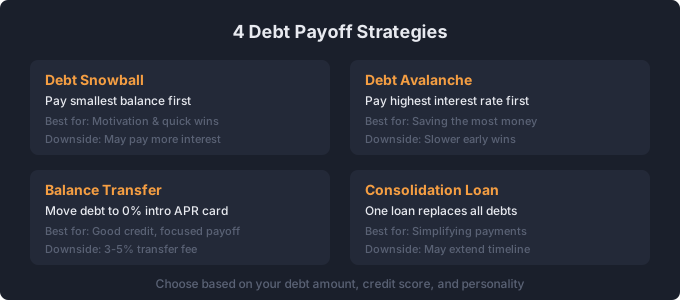
The avalanche method targets your highest-interest debt first. You make minimum payments on all cards, then throw every extra dollar at the card with the highest APR. Once that card is paid off, you roll that payment into the next-highest rate card.
Why it works: This method saves the most money in interest over time. If you have a card at 28% APR and another at 19% APR, eliminating the 28% balance first stops the most expensive interest from compounding. On $6,500 across two cards, the avalanche method typically saves $400 to $1,200 compared to the snowball method, depending on balance distribution and rates.
Best for: People motivated by math and long-term savings. If seeing the numbers shrink keeps you going, this is your method.
Strategy 2: The Debt Snowball Method
The snowball method ignores interest rates entirely. Instead, you pay off your smallest balance first while making minimums on everything else. Once the smallest debt is gone, you roll that payment into the next-smallest balance.
Why it works: Quick wins build momentum. Paying off a $300 balance in two months feels great and proves the system works. Research from Harvard Business School found that people using the snowball method were 14% more likely to eliminate all their debt compared to those using other strategies, simply because early wins kept them motivated.
Best for: People who need psychological wins to stay on track. If you have tried and failed to pay off debt before, the snowball method's built-in motivation system can make the difference.
Strategy 3: Balance Transfer Cards
A balance transfer card lets you move existing credit card debt to a new card with a 0% introductory APR — typically lasting 12 to 21 months. During that window, every dollar you pay goes directly to reducing your balance.
The math is compelling. On $6,500 at 0% APR for 18 months, a payment of $361/month pays off the entire balance with zero interest. The same $361/month at 24% APR would leave you with a remaining balance of about $1,100 after 18 months because interest keeps accumulating.
Watch out for: Balance transfer fees (typically 3% to 5%, or $195 to $325 on $6,500), the promotional period expiration (rates jump to 22% to 29% afterward), and the temptation to run up new charges on the old card. This strategy only works if you commit to paying off the balance before the 0% period ends and you stop adding new debt.
Strategy 4: Debt Consolidation Loans
A personal loan from a bank, credit union, or online lender lets you consolidate multiple credit card balances into one fixed-rate loan. In 2026, borrowers with good credit (680+) can find rates between 7% and 12% — far lower than the 24% average credit card APR.
Consolidating $6,500 at 9% over 36 months means a fixed payment of about $207/month and total interest of roughly $930. Compare that to the $9,800 in interest from minimum credit card payments. The savings are substantial, and the fixed payment schedule means you have a guaranteed payoff date.
Best for: People with decent credit who want predictability. A fixed monthly payment and a set end date remove the guesswork from debt repayment.
Your Step-by-Step Action Plan
Step 1: List every credit card balance. Include the card name, current balance, APR, and minimum payment. Most people discover they owe more than they thought once everything is written down.
Step 2: Pick your payoff strategy. Choose avalanche (save the most money), snowball (build motivation), balance transfer (0% interest window), or consolidation (lower fixed rate). There is no wrong answer — the best strategy is the one you will actually stick with.
Step 3: Set a fixed monthly payment. Decide how much you can pay toward debt each month above the combined minimums. Even an extra $100/month on $6,500 at 24% cuts your payoff time from 17 years to about 5 years and saves you over $6,000 in interest.
Step 4: Automate payments. Set up automatic payments for at least the minimum on every card, then a separate automatic payment for the extra amount toward your target card. Automation removes the temptation to skip a month.
Step 5: Stop adding new debt. Put your credit cards in a drawer, freeze them in a block of ice, or remove them from online shopping accounts. You cannot fill the tub while the drain is open.
Cut Expenses to Accelerate Your Payoff
Finding an extra $100 to $300 per month is easier than most people think. Start with subscriptions — the average American spends $84/month on subscriptions, and most people have at least one or two they have forgotten about. Cancel or downgrade streaming services, pause gym memberships you do not use, and switch to free alternatives where possible.
Other quick wins: cook at home two more nights per week (saves $120 to $200/month), bring lunch to work (saves $100 to $150/month), and negotiate your car insurance and phone bill (average savings of $50 to $80/month). Every dollar you redirect to credit card payments accelerates your payoff and reduces total interest.
Staying Motivated When It Gets Hard
Debt payoff is a marathon, not a sprint. Here are proven psychological strategies to keep going.
Track your progress visually. Use a chart, spreadsheet, or our debt payoff calculator to see your balance drop over time. Watching the line go down is genuinely motivating.
Celebrate milestones. Every $1,000 paid off deserves recognition — a nice meal, a movie night, something small that does not add new debt. The journey is long enough that you need rewards along the way.
Find an accountability partner. Tell a friend or family member about your goal. People who share their debt payoff goals with someone else are significantly more likely to follow through.
Remember your "why." Write down what being debt-free means to you — less stress, more freedom, the ability to save for things that matter. Keep that note where you will see it when temptation strikes.
See your payoff timeline
Enter your balances, rates, and monthly payment to get a personalized payoff plan. Free, no signup required.
Open Debt Payoff CalculatorRelated tools
Debt Payoff Calculator — Build a personalized payoff plan with snowball or avalanche
50/30/20 Budget Calculator — Find room in your budget for extra debt payments
Subscription Tracker — Cancel forgotten subscriptions and redirect savings to debt
Related guides
Debt Snowball vs Avalanche Explained — Detailed comparison of both methods
Understanding Your Credit Score — How paying off debt improves your score