Roth IRA vs Traditional IRA: Which Should You Choose?
Published April 2026 · 10 min read
This article is for informational purposes only and does not constitute financial advice. See our full disclaimer.
Choosing between a Roth IRA and a Traditional IRA is one of the most important retirement decisions you will make. Both accounts let you invest for the future with significant tax advantages, but they work in opposite ways. One gives you a tax break today. The other gives you tax-free income in retirement. The right choice depends on your current income, your expected future tax rate, and when you want the tax benefit to kick in.
This guide explains how each account works, compares them side by side, and helps you decide which one fits your situation in 2026.
How a Traditional IRA Works
A Traditional IRA gives you a tax deduction today. When you contribute money, you can deduct that amount from your taxable income for the year. If you contribute the full $7,000 and you are in the 22% tax bracket, you save $1,540 on your current tax bill.
The money grows tax-deferred inside the account, meaning you pay no taxes on gains, dividends, or interest while it is invested. However, when you withdraw money in retirement (after age 59 1/2), every dollar comes out as taxable income. You also face required minimum distributions (RMDs) starting at age 73, which force you to withdraw — and pay taxes on — a portion of your balance each year whether you need the money or not.
The Traditional IRA is essentially a deal with the IRS: skip taxes now, pay them later. This works best when you expect to be in a lower tax bracket in retirement than you are today.
How a Roth IRA Works
A Roth IRA flips the tax benefit. You contribute money that has already been taxed — there is no deduction today. But once the money is inside the Roth, it grows completely tax-free. When you withdraw in retirement, you pay $0 in taxes on the gains, the dividends, and the original contributions. Nothing.
Roth IRAs also have no required minimum distributions. You can leave the money invested for as long as you want, pass it to heirs, or withdraw it on your own schedule. Additionally, you can withdraw your original contributions (not the gains) at any time, for any reason, with no penalties or taxes. This makes the Roth more flexible than a Traditional IRA if you need emergency access to your money.
The Roth works best when you expect your tax rate to be the same or higher in retirement, or if you value the certainty of knowing exactly what your retirement withdrawals will be worth after taxes.
2026 Contribution Limits
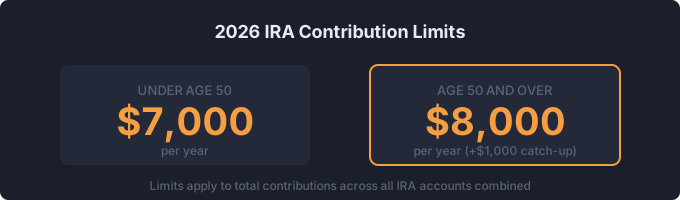
- Under age 50: $7,000 per year
- Age 50 and older: $8,000 per year (includes $1,000 catch-up contribution)
These limits apply across both accounts combined. You cannot contribute $7,000 to a Roth and another $7,000 to a Traditional — the total across all IRAs must stay within the annual limit.
Roth IRA Income Limits (2026)
Unlike the Traditional IRA, the Roth IRA has income restrictions on who can contribute directly:
- Single filers: Full contribution if MAGI is under $150,000. Reduced contribution between $150,000 and $165,000. No direct contribution above $165,000.
- Married filing jointly: Full contribution if MAGI is under $236,000. Reduced between $236,000 and $246,000. No direct contribution above $246,000.
If your income exceeds these limits, you may still be able to use a backdoor Roth strategy, which we cover below.
Side-by-Side Comparison
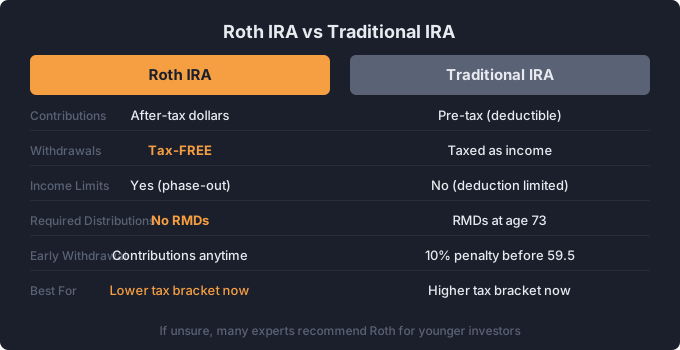
| Feature | Traditional IRA | Roth IRA |
|---|---|---|
| Tax break timing | Tax deduction now | Tax-free withdrawals later |
| Contributions taxed? | No (pre-tax) | Yes (after-tax) |
| Withdrawals taxed? | Yes (ordinary income) | No |
| 2026 limit (under 50) | $7,000 | $7,000 |
| 2026 limit (50+) | $8,000 | $8,000 |
| Income limits? | Deduction may phase out | Yes — contribution phases out |
| RMDs required? | Yes, starting at age 73 | No |
| Early withdrawal | 10% penalty + taxes | Contributions anytime; gains after 59 1/2 |
| Best for | Higher income now, lower in retirement | Lower income now, higher in retirement |
When to Choose a Roth IRA
A Roth IRA is typically the better choice in these situations:
- You are early in your career and earning less than you expect to earn later. Paying taxes on a $45,000 salary now to avoid taxes on retirement withdrawals at a potentially higher rate is a strong trade.
- You are in the 12% or 22% tax bracket. Locking in a low tax rate now and letting decades of growth compound tax-free is one of the most powerful wealth-building moves available.
- You want flexibility. The ability to withdraw contributions penalty-free makes the Roth a partial emergency fund backup, though it should not be your primary emergency fund.
- You believe tax rates will rise. If Congress raises income tax rates in the future, your Roth withdrawals remain completely untaxed regardless.
When to Choose a Traditional IRA
A Traditional IRA makes more sense when:
- You are in a high tax bracket now (32% or above) and expect to be in a lower bracket in retirement. The upfront deduction saves you real money today.
- You need to reduce your current taxable income. The deduction can lower your adjusted gross income, which may help you qualify for other tax credits or deductions.
- You do not qualify for Roth contributions due to income limits and do not want to deal with the backdoor Roth process.
- You are close to retirement and the money will be withdrawn in a lower-income period within 10–15 years.
The Backdoor Roth Strategy
If your income exceeds the Roth IRA limits, you are not entirely out of luck. The backdoor Roth is a legal two-step process:
- Step 1: Contribute $7,000 to a Traditional IRA (non-deductible contribution).
- Step 2: Convert the Traditional IRA to a Roth IRA shortly after.
Since you did not take a tax deduction on the contribution, you owe little to no tax on the conversion. The result is that your money ends up in a Roth IRA, growing tax-free, regardless of your income level. This strategy works cleanly if you have no other pre-tax IRA balances. If you do, the pro-rata rule applies and the conversion becomes partially taxable. Consult a tax professional before attempting this if you have existing Traditional IRA balances.
Your Starting Checklist
- Check your tax bracket. If you are in the 12% or 22% bracket, the Roth is almost always the better choice for long-term growth.
- Verify your income. Make sure you are under the Roth income limits, or plan to use the backdoor strategy.
- Open the account. Fidelity, Schwab, and Vanguard all offer both IRA types with no account minimums and no fees.
- Set up automatic contributions. Even $100/month ($1,200/year) starts building your retirement savings.
- Choose your investments. A target-date fund or a simple S&P 500 index fund is a solid starting point.
- Track your progress. Use our compound interest calculator to project how your IRA will grow over time.
The most important step is simply opening the account and contributing regularly. Whether you choose Roth or Traditional, either one puts you far ahead of the 55% of Americans who have no retirement savings outside of Social Security. Start with what you can afford and increase over time.
See how your IRA grows over time
Model different contribution amounts and returns with our free calculator.
Open Compound Interest Calculator →Related tools
Compound Interest Calculator — Project your retirement savings growth
Savings Goal Calculator — Plan how much to save each month
Net Worth Calculator — See your full financial picture
Related guides
Investing for Beginners — How to start with little money
Index Funds Explained — Why they are popular for beginners