Investing for Beginners: How to Start with Little Money
Published April 2026 · 10 min read
This article is for informational purposes only and does not constitute financial advice. See our full disclaimer.
Investing can feel intimidating when you are starting from scratch. The financial industry is full of jargon, the market swings up and down on any given day, and it seems like you need thousands of dollars just to get started. None of that is true anymore. In 2026, you can open an investment account with $0 minimum, buy fractional shares for as little as $1, and start building long-term wealth with a contribution as small as $25 per month.
The biggest risk is not investing badly. It is not investing at all. Every year you wait costs you real money in lost compound growth. This guide breaks down exactly how to get started, what to invest in, and which mistakes to avoid.
Why Investing Matters
A savings account earns roughly 4–5% APY in 2026, which barely keeps pace with inflation. Over the last century, inflation has averaged about 3% per year. That means money sitting in a basic checking account loses purchasing power every single year. A dollar today buys less than a dollar did last year, and the gap widens over time.
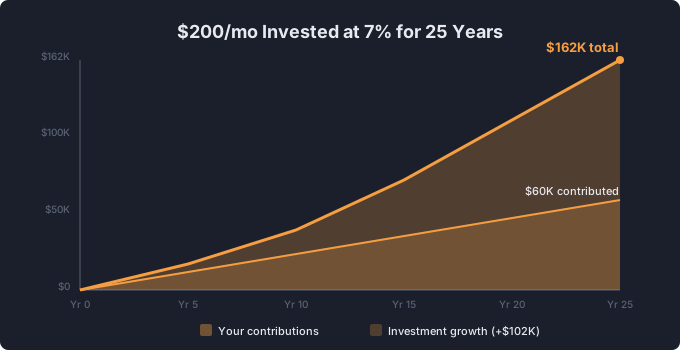
Investing in the stock market has historically returned an average of 7–10% annually after inflation. That difference compounds dramatically over decades. If you invest $200 per month starting at age 25 and earn an average 7% annual return, you would have approximately $243,000 by age 50. Your total contributions would only be $60,000 — the remaining $183,000 comes entirely from compound growth.
Even smaller amounts matter. Investing just $50 per month at 7% for 30 years produces roughly $61,000. That is $43,000 in growth on only $18,000 of your own money. Time in the market is the most powerful advantage a beginner has.
Getting Started: Opening a Brokerage Account
To invest, you need a brokerage account. Think of it like a bank account, but instead of just holding cash, it lets you buy stocks, bonds, and funds. In 2026, several major platforms offer $0 account minimums and $0 trading commissions.
- Fidelity — No minimums, fractional shares starting at $1, strong research tools, and no account fees.
- Charles Schwab — No minimums, excellent customer service, and a wide selection of index funds.
- Vanguard — The pioneer of low-cost investing, ideal for long-term index fund investors.
- Robinhood — Simple mobile-first interface, fractional shares, and no commissions. Popular with beginners.
Opening an account takes about 10 minutes. You will need your Social Security number, a bank account for transfers, and basic personal information. Once your account is open and funded, you can start buying investments immediately.
Types of Investments
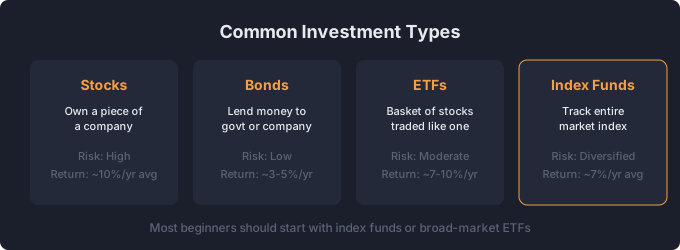
Before you buy anything, understand what is available. There are four main types of investments beginners should know about.
Stocks
A stock is a small ownership share in a company. When the company grows and earns more money, the stock price typically rises. You profit when you sell for more than you paid. Stocks offer the highest potential returns but also the highest short-term volatility. Individual stocks can drop 20–50% or more in a single year, which is why diversification matters.
Bonds
A bond is a loan you make to a government or corporation. They pay you interest over a set period, then return your principal. Bonds are generally more stable than stocks but offer lower returns — typically 3–5% annually. They act as a stabilizer in a diversified portfolio.
ETFs (Exchange-Traded Funds)
An ETF bundles hundreds or thousands of stocks or bonds into a single investment you can buy like a stock. Instead of picking individual companies, you buy one ETF and instantly own a piece of every company in it. This is the easiest way for beginners to get diversified exposure. Popular options include funds that track the S&P 500 or the total U.S. stock market.
Index Funds
Index funds are similar to ETFs but are structured as mutual funds. They track a market index like the S&P 500 and have extremely low fees — often 0.03% to 0.10% per year. Warren Buffett has famously recommended S&P 500 index funds as the best investment for most people. For a deeper look, see our guide on how index funds work.
Understanding Risk Tolerance
Risk tolerance is how much portfolio volatility you can handle without panicking and selling. It depends on two factors: your time horizon and your emotional comfort level.
If you are in your 20s or 30s investing for retirement 30+ years away, you can afford to be aggressive — meaning 80–100% stocks. Short-term drops do not matter because you have decades for the market to recover. If you are investing money you will need in 3–5 years, a more conservative mix of 50–60% stocks and 40–50% bonds reduces the chance of a poorly timed downturn wiping out your savings.
A common rule of thumb is to subtract your age from 110 to get your stock allocation percentage. At age 30, that means 80% stocks and 20% bonds. At age 50, it shifts to 60% stocks and 40% bonds. This is a starting point, not a fixed rule.
Dollar-Cost Averaging: The Beginner's Best Strategy
Dollar-cost averaging means investing a fixed amount on a regular schedule — say $100 every two weeks — regardless of what the market is doing. When prices are high, your $100 buys fewer shares. When prices are low, it buys more. Over time, this smooths out your average purchase price and removes the impossible task of trying to time the market.
This strategy works because it is automatic and emotion-free. You do not need to decide whether today is a good day to invest. You simply invest on your schedule every time. Most brokerages let you set up automatic recurring investments so the money moves from your bank account into your chosen funds without you lifting a finger.
Common Beginner Mistakes
1. Trying to time the market. Even professional fund managers fail to consistently time the market. Studies show that missing just the 10 best trading days over a 20-year period can cut your returns in half. The solution is to stay invested consistently.
2. Panic selling during downturns. Markets drop. It happens every few years. The S&P 500 has experienced a decline of 10% or more roughly once every 18 months on average. Every single time, it has eventually recovered and gone on to reach new highs. Selling during a downturn locks in your losses permanently.
3. Chasing hot stocks or trends. By the time you hear about a stock on social media, the easy gains are usually gone. Concentrating your money in one or two stocks exposes you to enormous risk. Diversified index funds are boring but effective.
4. Paying high fees. A 1% annual management fee might sound small, but over 30 years it can consume $100,000+ of your returns on a $500,000 portfolio. Choose low-cost index funds with expense ratios below 0.20%.
5. Waiting for the perfect moment. There is no perfect moment. The best time to start investing was years ago. The second best time is right now. Even starting with $25 per month builds the habit and gets compound growth working in your favor.
Starting with $25 Per Month
You do not need a large lump sum. Here is a simple plan to start investing with $25 per month:
- Step 1: Open a brokerage account with Fidelity, Schwab, or another $0-minimum platform.
- Step 2: Set up a recurring transfer of $25 from your bank account on each payday.
- Step 3: Choose a single total stock market index fund or S&P 500 ETF (like VTI or VOO).
- Step 4: Enable automatic investing so the money is put to work without manual action.
- Step 5: Increase your contribution by $10–$25 whenever you get a raise or pay off a bill.
At $25/month earning 7%, you will have approximately $20,300 in 25 years — from just $7,500 in total contributions. Bump that up to $100/month and you are looking at over $81,000. The key is starting now and increasing over time.
To see exactly how your money could grow, try our compound interest calculator and plug in your own numbers.
See how your money grows over time
Use our free compound interest calculator to model different investment scenarios.
Open Compound Interest Calculator →Related tools
Compound Interest Calculator — See how investments grow over time
Savings Goal Calculator — Plan your savings targets
Net Worth Calculator — Track your full financial picture
Related guides
Index Funds Explained — Why they are popular for beginners
Compound Interest Explained — The force behind long-term wealth