How to Budget Your Paycheck — A System That Works
March 2026 · 6 min read
This article is for informational purposes only and does not constitute financial advice. See our full disclaimer.
The best time to budget is the moment you get paid. Before the money scatters, give every dollar a purpose. This takes 10 minutes and eliminates the "where did my money go?" feeling.
The 4-step payday system
1. Start with take-home pay
Budget what hits your bank account, not gross pay. If your salary is $55,000 per year, your gross biweekly check is about $2,115 — but after taxes, health insurance, and retirement contributions, your take-home might be closer to $1,650. That $1,650 is your real starting number. Use the paycheck budget calculator to allocate every dollar.
2. Pay bills first
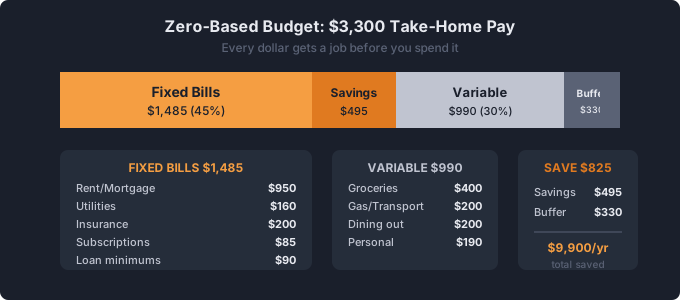
Rent, utilities, insurance, loan minimums, subscriptions. List every fixed expense and subtract it from your paycheck. For example, if your biweekly take-home is $1,650 and your fixed bills total $1,050 (rent $650, utilities $85, car insurance $95, phone $45, subscriptions $85, loan minimum $90), you have $600 left. That is your actual spendable money. What is left after fixed bills is the only number that matters.
3. Pay yourself second
Move money to savings before spending anything discretionary. Even $50/paycheck = $1,200/year. If you can manage $100 per paycheck, that is $2,600 per year — enough to build a solid emergency fund in under 5 months. Set up an automatic transfer so the money moves on payday before you have a chance to spend it. Use the savings calculator to set a specific target amount and timeline.
4. Allocate the rest
Remaining money covers groceries, gas, and fun. Using our example: $600 left minus $100 to savings = $500 for two weeks of variable spending. Divide by 14 days and you get roughly $36 per day. That daily budget number is powerful — it turns an abstract biweekly budget into a simple daily decision. If you spend $20 on Monday, you have $52 available on Tuesday. It keeps you accountable without a complicated spreadsheet.
Budget killer: forgotten subscriptions
Americans spend $84/month on subscriptions in 2026. Run a subscription audit — you'll find $20-50/month to reclaim.
When your paycheck isn't enough
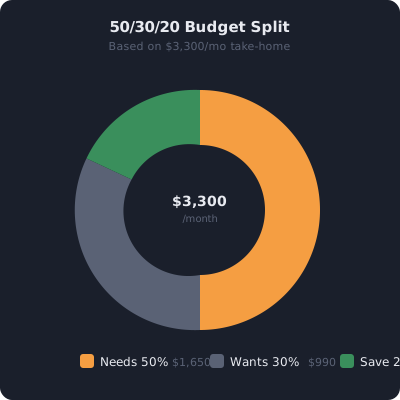
If bills exceed income, audit subscriptions, shop insurance, negotiate bills. The 50/30/20 calculator shows ideal percentages — if needs exceed 50%, something needs to change.
Start with the easiest wins. Call your car insurance company and ask for a rate review — many people save $30-$60 per month just by asking. Switch to a cheaper phone plan (prepaid plans often run $25-$35 per month versus $75+ for major carriers). Cancel streaming services you have not used in the past 30 days. These small changes can free up $100-$200 per month without any lifestyle change.
Common budgeting mistakes
Not accounting for irregular expenses
Car registration, holiday gifts, annual insurance premiums, vet bills — these expenses are predictable but not monthly. If you spend $1,200 per year on irregular expenses, that is $100 per month you should be setting aside. Create a "sinking fund" category in your budget: set aside $50-$100 per paycheck into a separate savings account earmarked for these costs. When the bill arrives, the money is already there.
Forgetting about subscriptions
The average American has 6-8 active subscriptions, and many people underestimate what they spend by $20-$40 per month. Free trials that auto-convert, annual renewals you forgot about, and services you share with an ex — these add up fast. Run a subscription audit every quarter. Use the subscription tracker to catch every recurring charge.
Not adjusting after a raise
Lifestyle creep is the silent budget killer. When you get a $3,000 raise (roughly $115 extra per biweekly paycheck after taxes), commit at least half of it to savings or debt payoff before adjusting your spending. If you immediately upgrade your lifestyle to match every raise, you will always feel like you do not earn enough.
How to handle irregular income
Freelancers, gig workers, and commission-based earners face a unique challenge: your paycheck is different every time. The standard budgeting advice does not quite work when you do not know what you will earn next month. Here is how to adapt.
Build a baseline budget
Look at your last 6-12 months of income and find your lowest earning month. Build your fixed budget around that number. If your income ranged from $2,800 to $5,200 over the past year, budget your essentials around $2,800. This means your bills, minimum debt payments, and basic groceries should fit within that floor amount.
Use a buffer account
In months where you earn more than your baseline, move the surplus into a separate checking account that acts as a buffer. When you have a low month, draw from the buffer to cover the gap. Aim to build a buffer equal to one full month of expenses (around $3,000-$4,000 for most people). This turns irregular income into steady, predictable cash flow.
Pay yourself a salary
Once your buffer is established, transfer a fixed amount to your personal checking account on the 1st and 15th of each month — just like a regular paycheck. If your average monthly income is $4,000, pay yourself $2,000 twice a month. Budget from those fixed transfers, not from your actual deposit amounts. This approach removes the stress of variable income entirely.
Automating your budget
The less you have to think about your budget, the more likely you are to stick with it. Automation removes willpower from the equation.
Split your direct deposit
Most employers let you split your paycheck across multiple bank accounts. Send your fixed bill amount directly to a bills-only checking account, your savings target to a savings account, and the remainder to your spending account. You never have to manually transfer money or remember to pay yourself first — it happens before you even see the deposit.
Set up auto-transfers
If your employer does not offer direct deposit splitting, set up automatic transfers at your bank for the day after payday. Schedule a $100 transfer to savings every payday. Schedule your rent payment for the same day. The goal is to have all fixed obligations handled within 24 hours of getting paid, so the remaining balance in your checking account is truly yours to spend.
Use calendar reminders for manual tasks
Some bills cannot be automated (or you prefer manual control over certain payments). Set phone reminders for the day after each payday: review your account, confirm auto-transfers went through, and handle any manual payments. This 5-minute check-in keeps your system running without requiring daily attention to your finances.
Budget your next paycheck
Enter your take-home pay and allocate every dollar.
Open Paycheck Calculator →Related tools
Paycheck Budget Calculator · 50/30/20 Calculator · Subscription Tracker