How to Budget on Irregular Income
April 2026 · 9 min read
This article is for informational purposes only and does not constitute financial advice. See our full disclaimer.
Budgeting is hard enough with a predictable paycheck. When your income changes every month — sometimes dramatically — traditional budgeting advice falls apart. You cannot allocate 50% of your income to needs when you don't know what your income will be.
Over 36% of U.S. workers now earn some form of irregular income, including freelancers, gig workers, commission-based employees, small business owners, and seasonal workers. If you fall into any of these categories, the standard budgeting methods need to be adapted. Here is how to make it work.
Why Traditional Budgets Fail with Variable Income
Most budgeting advice assumes a fixed monthly paycheck. The 50/30/20 rule says to put 50% toward needs — but 50% of what? If you earned $7,000 last month and $3,000 this month, your needs don't shrink by 57%. Rent stays the same. Insurance stays the same. Groceries don't get cut in half.
The core problem is that your expenses are fixed while your income is not. This mismatch causes a cycle that many freelancers know well: feast months lead to overspending, and lean months lead to panic, debt, or dipping into savings that were meant for other goals. Breaking this cycle requires a different approach to budgeting entirely.
Method 1: Baseline Budgeting
The most reliable strategy for irregular income is baseline budgeting. Instead of budgeting based on what you expect to earn or what you earned last month, you budget based on your lowest realistic monthly income.
Look at the past 12 months of income. Find the lowest month. That number becomes your budget baseline. Everything above it is treated as surplus to be allocated according to a priority system.
Real Example: Freelancer Earning $3K–$7K/Month
Suppose you are a freelance graphic designer. Over the past year, your monthly income ranged from $3,200 to $6,800. Your baseline budget is built on $3,200.
At $3,200/month, your budget might look like this:
- Rent: $1,100
- Utilities: $130
- Groceries: $350
- Insurance (health + car): $420
- Phone + internet: $110
- Gas/transportation: $100
- Subscriptions: $65
- Minimum debt payments: $200
- Emergency buffer: $200
- Personal/misc: $125
- Total: $2,800
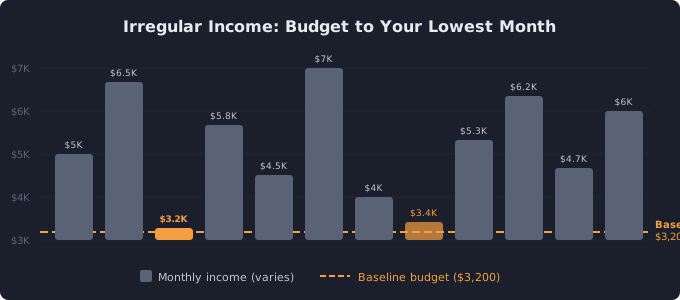
That leaves $400 of your $3,200 baseline unallocated. This margin is critical. It absorbs unexpected expenses without blowing up your budget.
Now, in a month where you earn $5,500 instead of $3,200, you have $2,300 in surplus. This surplus gets allocated using your priority list (covered below), not spent freely.
Method 2: The Buffer Account Strategy
A buffer account is a dedicated savings account that smooths out income fluctuations. The goal is to build a buffer equal to 2 to 3 months of expenses — separate from your emergency fund. All income goes into the buffer first. Then you pay yourself a fixed monthly "salary" from the buffer into your checking account.
Here is how it works in practice:
- Step 1: Open a separate high-yield savings account. This is your buffer.
- Step 2: Deposit all client payments and income into this buffer account.
- Step 3: On the 1st of each month, transfer a fixed amount — your personal "salary" — to your checking account. Use your average monthly income minus 10-15% as the transfer amount.
- Step 4: Budget your checking account as if it were a regular paycheck.
For the freelancer earning $3K–$7K, the average is roughly $5,000/month. A conservative personal salary might be $4,200/month. In good months, the buffer grows. In lean months, the buffer covers the gap. As long as your annual income supports your annual expenses, the system works.
The buffer needs to reach $8,400 to $12,600 (2-3 months of the $4,200 salary) before you can rely on this system fully. Until then, start with the baseline method and build the buffer over time by directing surplus income into it.
Method 3: Pay Yourself a Salary
This is a variation of the buffer strategy, commonly used by freelancers who have been self-employed for 2+ years and have predictable annual income even if monthly totals vary.
Calculate your total income from the past 12 months. Divide by 12. Subtract 15% for taxes (if not already withheld) and another 10% for a safety margin. The result is your monthly salary.
Example: $60,000 annual freelance income divided by 12 equals $5,000/month. Subtract 15% for taxes ($750) and 10% safety margin ($500). Your monthly salary is $3,750. You budget and spend as if that is your fixed paycheck. Surplus accumulates in your business or buffer account for taxes, lean months, and annual expenses.
Prioritizing Expenses in Tiers
When income is unpredictable, you need a clear priority system for how surplus money gets allocated. Not all spending is equally important, and in lean months, you need to know exactly what gets cut first.
Tier 1: Non-Negotiable (Must pay every month)
Rent/mortgage, utilities, groceries, insurance, minimum debt payments, transportation to work. These get funded first, no matter what. Total in our example: $2,310.
Tier 2: Important (Fund if income exceeds Tier 1)
Emergency fund contributions ($300), extra debt payments ($200), subscriptions and phone ($175), basic personal spending ($150). Total: $825.
Tier 3: Growth (Fund in good months)
Retirement contributions ($400), buffer account building ($300), savings goals — vacation, equipment, education ($200). Total: $900.
Tier 4: Lifestyle (Fund only in great months)
Dining out ($200), entertainment ($100), clothing and personal care ($100), gifts and donations ($100). Total: $500.
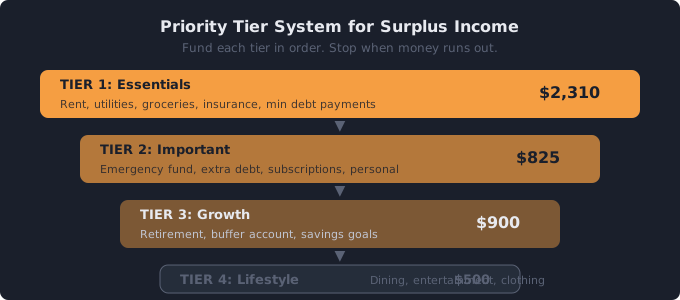
In a $3,200 month, you fully fund Tier 1 and partially fund Tier 2. In a $5,500 month, you fund Tiers 1 through 3 completely and put the remaining $465 toward Tier 4 or extra savings. In a $7,000 month, everything gets funded with surplus left over for your buffer account.
Adjusting Monthly: The 15-Minute Review
With irregular income, a monthly budget review is not optional. At the end of each month, spend 15 minutes on three things:
1. Record actual income. Write down exactly what came in. Compare it to your baseline and note whether it was a lean, normal, or surplus month.
2. Check your buffer balance. Is it growing, stable, or shrinking? If it has dropped below one month of expenses for two consecutive months, you need to cut Tier 3 and 4 spending until it recovers.
3. Review subscriptions and recurring charges. Variable income makes recurring charges more dangerous. A $15/month subscription feels insignificant on a $6,000 month but represents real money on a $3,000 month. Use a subscription tracker to keep these visible and cut anything that is not delivering clear value.
Common Mistakes with Irregular Income
Treating good months as normal. The biggest mistake freelancers make is spending a $7,000 month as if every month will be $7,000. It won't. Surplus months are for building your buffer, funding savings goals, and paying down debt — not for lifestyle inflation.
Not saving for taxes. If you are self-employed, set aside 25-30% of every payment for taxes before you budget. This is not optional. Failing to do this is the single most common financial crisis among freelancers. Move tax money into a separate account the day it arrives.
Skipping the emergency fund. An emergency fund is even more critical with irregular income than with a salary. Aim for $5,000 to $10,000 in an emergency fund, separate from your income buffer. This covers true emergencies — medical bills, car repairs, equipment failure — without disrupting your monthly budget system.
Know exactly what you're paying monthly
Track every subscription and recurring charge so you know your true fixed costs — critical for budgeting on irregular income.
Open Free Subscription Tracker →Related tools
Subscription Tracker — See all your recurring charges in one place
50/30/20 Budget Calculator — Split any income amount into a balanced budget
Paycheck Budget Calculator — Plan spending around irregular pay dates
Related guides
Budgeting for Beginners — Start here if you're new to budgeting
The Envelope Budgeting Method Explained — A disciplined approach that pairs well with variable income