Budgeting for Beginners: A No-Nonsense Guide
April 2026 · 9 min read
This article is for informational purposes only and does not constitute financial advice. See our full disclaimer.
Most people know they should budget. Very few actually do. According to recent surveys, roughly 74% of Americans don't follow a detailed monthly budget. The reasons are predictable: it feels restrictive, it takes time, and most people assume they have a general sense of where their money goes. That assumption is almost always wrong.
The average American underestimates their monthly spending by $200 to $400. Subscriptions, impulse purchases, and small daily expenses compound into amounts that are genuinely surprising when tallied. A budget does not fix everything overnight, but it does one critical thing: it replaces guessing with knowing.
This guide walks through the three most popular budgeting methods, shows you how to build your first budget step by step, and highlights the mistakes that trip up most beginners.
Why Most People Don't Budget
The biggest barrier is not laziness. It is a combination of friction and misconception. Many people tried budgeting once, found it tedious, and gave up within a week. Others believe budgeting means extreme frugality, cutting out everything enjoyable. Neither is true.
A budget is simply a plan for your money. It tells each dollar where to go before the month starts, instead of wondering where it went after the month ends. You can still eat out, buy things you enjoy, and live your life. The difference is that you are doing it intentionally, with full visibility into the trade-offs.
The other common objection is time. People assume budgeting requires hours of spreadsheet work every week. In practice, the initial setup takes 30 to 60 minutes. After that, a weekly check-in of 10 minutes is enough to stay on track. The return on that small time investment is hundreds of dollars per month in savings for most households.
The 3 Most Popular Budgeting Methods
1. The 50/30/20 Rule
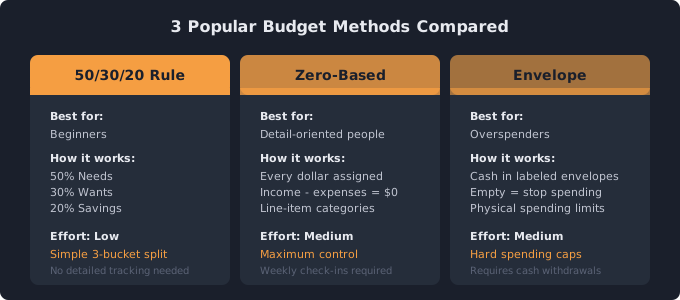
This is the simplest method and the best starting point for most beginners. You divide your after-tax income into three categories: 50% for needs (rent, utilities, groceries, insurance, minimum debt payments), 30% for wants (dining out, entertainment, subscriptions, shopping), and 20% for savings and extra debt payments.
On a $4,000/month take-home, that breaks down to $2,000 for needs, $1,200 for wants, and $800 for savings. The beauty of this method is its simplicity. You don't need to track every purchase to the penny. You just need to keep each bucket within its limit. Our 50/30/20 budget calculator does the math instantly.
2. Zero-Based Budgeting
With zero-based budgeting, every dollar of income is assigned a specific job. Income minus all planned expenses equals exactly zero. This does not mean you spend everything. It means savings, investments, and debt payments each get their own line item, just like rent and groceries.
On $4,000/month, you might allocate: rent $1,200, groceries $400, car payment $350, utilities $150, insurance $200, gas $120, subscriptions $85, dining out $200, entertainment $100, clothing $75, savings $500, extra debt payment $300, and miscellaneous $320. Every dollar is accounted for.
This method gives you maximum control and awareness. The trade-off is that it requires more upfront planning and weekly maintenance than the 50/30/20 approach.
3. The Envelope Method
The envelope method assigns cash to physical envelopes labeled by spending category. When the envelope is empty, you stop spending in that category until next month. It is the most disciplined approach and works especially well for people who struggle with overspending on credit and debit cards.
For a digital version of this concept, many people use separate savings accounts or budgeting apps that simulate the envelope system. The core principle is the same: finite, visible limits on each category of spending.
Building Your First Budget: Step by Step
Let's walk through creating a budget using a $4,000/month take-home pay example. This works regardless of which method you choose.
Step 1: Calculate your actual take-home pay. This is what hits your bank account after taxes, health insurance, and retirement contributions. Do not use your salary. Use the net amount deposited. If your income varies, use the average of the last three months or your lowest recent month for a conservative estimate.
Step 2: List every fixed expense. These are bills that stay roughly the same each month: rent or mortgage ($1,200), car payment ($350), insurance ($200), phone ($85), internet ($60), minimum debt payments ($150). Fixed expenses in this example total $2,045.
Step 3: Estimate your variable expenses. Pull up your bank and credit card statements from the past 3 months. Calculate your average spending on groceries ($400), gas ($120), dining out ($200), entertainment ($100), personal care ($50), and subscriptions ($85). Variable expenses here total $955.
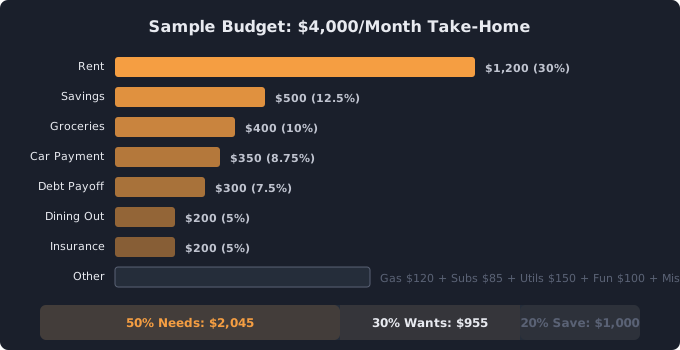
Step 4: Subtract and allocate the rest. $4,000 minus $2,045 minus $955 leaves $1,000. This is the money you direct toward savings and financial goals. A solid split: $500 to an emergency fund, $300 to extra debt payments, and $200 to a short-term savings goal like a vacation fund.
Step 5: Track for 30 days. Stick to your plan for one full month. At the end, compare your actual spending against your budget. Almost everyone overspends in at least one category the first month. That is expected. Adjust the numbers and try again.
Common Budgeting Mistakes
Setting unrealistic limits. If you currently spend $600/month on dining out and groceries combined, budgeting $200 for both will fail immediately. Cut by 10-20% the first month, then gradually tighten. Aggressive cuts lead to budget abandonment within two weeks.
Forgetting irregular expenses. Car registration, annual insurance premiums, holiday gifts, and medical co-pays are real costs that happen every year. Divide their annual total by 12 and include that amount in your monthly budget. A $1,200 annual car insurance bill is $100/month you need to plan for.
Not building in fun money. A budget with zero room for enjoyment will not last. Allocate a specific amount for discretionary spending guilt-free. Even $50 to $100/month for personal purchases prevents the feeling of deprivation that causes most people to quit.
Ignoring subscriptions. The average American spends $84/month on subscriptions, and most underestimate the total by 40%. Use a subscription tracker to identify every recurring charge before building your budget.
When to Adjust Your Budget
Your budget is not static. Review and adjust it when any of these happen: a raise or pay cut, a new recurring expense (like a car payment), a major life change (moving, new baby, new job), reaching a savings goal, or paying off a debt. Most financial experts recommend a full budget review every quarter, with quick weekly check-ins to make sure you are on track.
The goal is not perfection. It is awareness. People who budget consistently, even imperfectly, save an average of $3,000 to $5,000 more per year than those who don't. That is the difference between having an emergency fund and not having one, between paying off debt in 3 years versus 7, and between retiring comfortably versus struggling.
See where your paycheck should go
Use our free paycheck budget calculator to split your income into needs, wants, and savings automatically.
Open Paycheck Budget Calculator →Related tools
50/30/20 Budget Calculator — Instantly split your income into needs, wants, and savings
Paycheck Budget Calculator — Plan your budget around your pay schedule
Subscription Tracker — Find and track every recurring charge
Related guides
The Envelope Budgeting Method Explained — Deep dive into cash-based budgeting
How to Budget on Irregular Income — Strategies for freelancers and gig workers