Debt Snowball vs Avalanche: Which Payoff Method Wins?
Published April 2026 · 10 min read
This article is for informational purposes only and does not constitute financial advice. See our full disclaimer.
If you have decided to get serious about paying off debt, you have probably encountered two popular strategies: the debt snowball and the debt avalanche. Both work. Both have passionate advocates. But they produce different results depending on your situation, your psychology, and your debt profile.
This guide breaks down exactly how each method works, runs the numbers on a realistic four-debt scenario totaling $23,000, and helps you decide which approach — or which hybrid — will get you to zero fastest.
How the Debt Snowball Works
The snowball method, popularized by personal finance author Dave Ramsey, is simple: pay off your smallest balance first, regardless of interest rate. You make minimum payments on all debts except the smallest one, which gets every extra dollar you can throw at it. Once that debt is gone, you roll its entire payment into the next-smallest balance.
The logic is psychological, not mathematical. Eliminating a debt completely — seeing a balance hit $0 — creates a rush of accomplishment. That momentum builds like a snowball rolling downhill, growing larger and faster as each debt is eliminated. You go from making progress on four debts to focusing all your firepower on one.
The key advantage: Early wins. If your smallest debt is $800, you might eliminate it in just 2 to 3 months. That quick victory proves the system works and keeps you engaged for the longer road ahead.
How the Debt Avalanche Works
The avalanche method is purely mathematical: pay off your highest-interest debt first, regardless of balance size. You make minimum payments on everything else and direct all extra money toward the debt charging you the most interest. Once that debt is eliminated, you move to the next-highest rate.
The logic is financial optimization. High-interest debt costs you the most money over time. Every dollar of principal you eliminate on a 28% APR card saves you $0.28 in annual interest, versus only $0.06 on a 6% student loan. By targeting expensive debt first, you minimize total interest paid across all your accounts.
The key advantage: You save more money. In virtually every debt scenario, the avalanche method results in less total interest paid and a slightly faster overall payoff compared to the snowball.
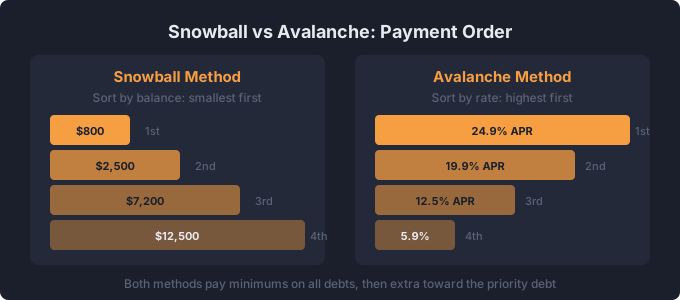
Real Example: 4 Debts Totaling $23,000
Let us run the numbers on a realistic debt profile. Imagine you have the following four debts and can afford to pay $800/month total toward all of them.
The Debts
- Medical bill: $2,200 balance, 0% APR, $50 minimum payment
- Credit card A: $4,800 balance, 22% APR, $96 minimum payment
- Credit card B: $7,000 balance, 28% APR, $140 minimum payment
- Personal loan: $9,000 balance, 11% APR, $195 minimum payment
Snowball Order (Smallest Balance First)
You would attack them in this order: medical bill ($2,200), credit card A ($4,800), credit card B ($7,000), personal loan ($9,000). With $800/month total, after covering minimums on the other three debts ($431), you have $369 extra for the target debt each month.
The medical bill is gone in about 6 months. Credit card A falls in another 10 months. Credit card B takes 9 more months. The personal loan is done in 7 more months. Total payoff time: approximately 32 months. Total interest paid: roughly $5,860.
Avalanche Order (Highest Interest First)
You would attack them in this order: credit card B (28%), credit card A (22%), personal loan (11%), medical bill (0%). With the same $800/month, after minimums on the other three ($341), you have $459 extra toward the target.
Credit card B is gone in about 12 months. Credit card A falls in 7 more months. The personal loan takes 8 more months. The medical bill is done in 3 more months. Total payoff time: approximately 30 months. Total interest paid: roughly $4,680.
The Verdict: Savings vs Momentum
In this example, the avalanche method saves approximately $1,180 in interest and pays off all debt 2 months sooner. That is a meaningful difference — $1,180 is real money that stays in your pocket instead of going to creditors.
However, with the snowball method, you get your first debt-free victory in 6 months instead of waiting 12 months for the first payoff. For many people, that early win is worth the extra cost because it prevents them from giving up entirely.
The worst strategy is the one you abandon. If the avalanche method's 12-month wait for a first victory causes you to lose motivation and stop making extra payments by month 8, you would have been better off with the snowball method that kept you engaged the entire time.
What the Research Says
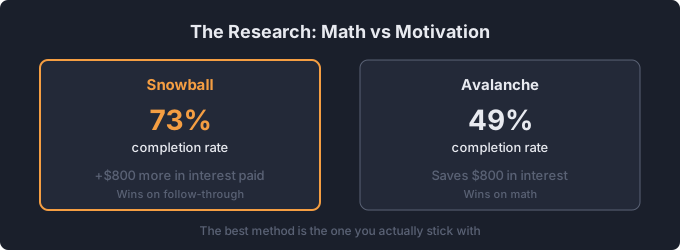
Studies on debt repayment behavior consistently favor the snowball method for completion rates. Research published in the Journal of Consumer Research found that people who focused on reducing the number of debt accounts (the snowball approach) repaid their debt faster in practice, even though the avalanche would have been cheaper in theory.
The reason is straightforward: debt repayment is a behavior problem, not just a math problem. The mathematically optimal strategy only works if you execute it consistently for years. The psychologically sustainable strategy works because you actually finish it.
That said, for people who are naturally disciplined, analytically minded, and motivated by seeing interest savings rather than account closures, the avalanche method works perfectly well. Know yourself before choosing.
The Hybrid Approach
You do not have to pick one method exclusively. A hybrid approach takes the best of both worlds.
Option 1: Snowball start, avalanche finish. Pay off your one or two smallest debts first to build momentum and simplify your finances. Then switch to the avalanche method for the remaining larger balances. This gives you early wins while still optimizing interest savings on the big debts.
Option 2: Avalanche with a quick win. If your smallest debt is under $500 and can be eliminated in one or two months, pay it off first regardless of its interest rate. Then switch to strict avalanche order. The minimal interest cost of this detour is easily worth the psychological boost.
Option 3: Rate-adjusted snowball. Pay off debts in order of smallest balance, but skip ahead to any debt with an APR above 25%. High-interest debt is so expensive that the math overwhelms the psychology — letting a 28% balance grow while you pay off a 6% loan costs real money every month.
Which Method Is Right for You?
Choose the snowball if: You have tried and failed to pay off debt before. You have many small balances that could be eliminated quickly. You are motivated by visible progress and checking items off a list. You need early wins to build confidence.
Choose the avalanche if: You are disciplined and patient. You have one or two debts with very high interest rates (above 24%). You are motivated by saving money and optimizing your finances. You can stay committed even without frequent milestones.
Choose a hybrid if: You have a mix of small balances and high-rate debts. You want psychological momentum without leaving too much money on the table. You are willing to be flexible and adjust your strategy as debts are eliminated.
Regardless of which method you choose, the most important step is to start. Run your specific numbers through a calculator, pick your order, set up automatic payments, and commit. The difference between snowball and avalanche is measured in hundreds or low thousands of dollars. The difference between any strategy and no strategy is measured in tens of thousands.
Run your own numbers
Enter your debts and see snowball vs avalanche payoff timelines side by side. Free, no signup required.
Open Debt Payoff CalculatorRelated tools
Debt Payoff Calculator — Compare snowball and avalanche payoff plans
50/30/20 Budget Calculator — Find extra money for debt payments
Subscription Tracker — Cancel unused subscriptions and redirect to debt
Related guides
How to Get Out of Credit Card Debt — Complete guide to all payoff strategies
Understanding Your Credit Score — How debt payoff impacts your score