Student Loan Repayment Strategies for 2026
Published April 2026 · 10 min read
This article is for informational purposes only and does not constitute financial advice. See our full disclaimer.
Student loan debt remains one of the largest financial burdens facing Americans in 2026. The average borrower graduates with roughly $37,000 in student loans, and total outstanding student debt in the U.S. exceeds $1.7 trillion. Whether you just finished school or have been making payments for years, choosing the right repayment strategy can save you thousands of dollars and years of payments.
The good news: you have more repayment options than ever. Federal plans, forgiveness programs, refinancing, and accelerated payment strategies each offer distinct advantages depending on your income, career path, and financial goals. This guide breaks down every major option so you can pick the one that fits your situation.
Federal Repayment Plans Explained
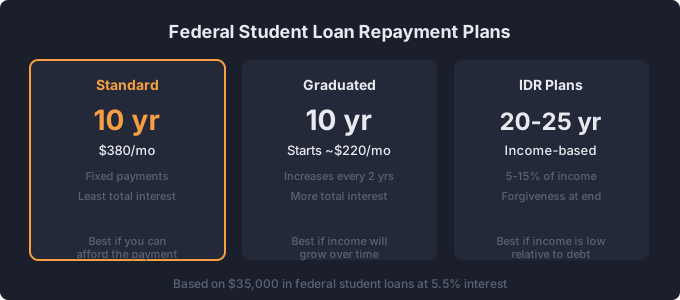
If you have federal student loans, you are automatically placed on the Standard Repayment Plan unless you choose otherwise. This plan sets fixed monthly payments over 10 years. For a $37,000 balance at 5.5% interest, that means roughly $401 per month and about $11,100 in total interest paid. It is the fastest way to pay off your loans without extra payments, but the monthly amount can be steep for early-career borrowers.
The Graduated Repayment Plan starts with lower payments that increase every two years over a 10-year term. Payments begin around $230/month and climb to roughly $600/month by the end. You will pay more total interest than the Standard plan, approximately $13,500, but the lower initial payments can help if your income is modest right out of school and you expect it to grow.
Income-Driven Repayment Plans
Income-driven repayment (IDR) plans cap your monthly payment at a percentage of your discretionary income. These are designed for borrowers whose loan balance is high relative to their earnings. In 2026, three main IDR plans are available.
SAVE Plan (Saving on a Valuable Education)
The SAVE plan replaced the older REPAYE plan and is the most generous IDR option for most borrowers. Payments are capped at 5% of discretionary income for undergraduate loans and 10% for graduate loans. The government covers any unpaid interest, so your balance will not grow even if your payments do not cover the full interest charge. For a borrower earning $45,000 with $37,000 in undergraduate debt, the monthly payment under SAVE would be approximately $128/month, compared to $401 on the Standard plan.
PAYE (Pay As You Earn)
PAYE caps payments at 10% of discretionary income and offers forgiveness after 20 years of qualifying payments. You must demonstrate financial hardship to enroll. PAYE is typically best for borrowers who took out their first loans after October 2007 and have a high debt-to-income ratio. Monthly payments for the same $45,000 earner would be around $197/month.
IBR (Income-Based Repayment)
IBR caps payments at 10% of discretionary income for new borrowers (those who took out loans after July 2014) or 15% for older borrowers. Forgiveness comes after 20 or 25 years depending on when you borrowed. IBR is widely available and does not require a hardship demonstration, making it a solid fallback if you do not qualify for SAVE or PAYE.
Student Loan Forgiveness Programs
Public Service Loan Forgiveness (PSLF)
If you work full-time for a qualifying employer, such as a government agency, nonprofit organization, or public school, your remaining federal loan balance can be forgiven after 120 qualifying monthly payments (10 years). There is no cap on the forgiveness amount and the forgiven balance is tax-free. To maximize PSLF, pair it with an IDR plan so your monthly payments stay low while the 120-payment clock ticks. A borrower on SAVE paying $128/month would pay approximately $15,360 total before the remaining balance is forgiven, compared to $48,100 on the Standard plan.
IDR Forgiveness
Even without PSLF, any remaining balance on an IDR plan is forgiven after 20 or 25 years of payments. The key difference: forgiven amounts under IDR may be treated as taxable income, though legislation has temporarily exempted student loan forgiveness from federal income tax through 2025. Check current tax law before counting on tax-free treatment in later years.
Should You Refinance?
Refinancing replaces your existing loans with a new private loan at a potentially lower interest rate. In 2026, refinance rates for well-qualified borrowers range from 4.5% to 6.5%, compared to federal rates of 5.5% to 7% for recent graduates. On a $37,000 balance, dropping your rate from 6.5% to 4.5% over 10 years saves approximately $4,100 in interest.
However, refinancing federal loans into a private loan means permanently giving up access to IDR plans, PSLF, forbearance, and other federal protections. This tradeoff only makes sense if you have a stable high income, do not qualify for forgiveness programs, and can secure a meaningfully lower rate. Never refinance if you are pursuing PSLF or expect to need income-driven payments.
The Math of Extra Payments
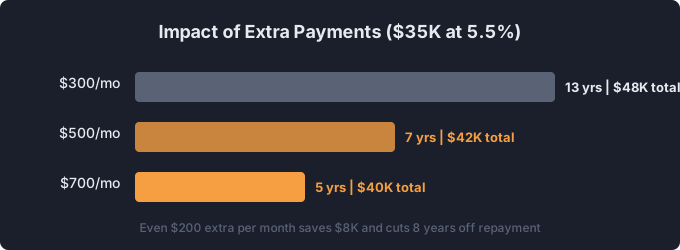
Making extra payments is the simplest way to save on interest and pay off loans faster. The impact is significant even with modest additional amounts.
Consider a $37,000 loan at 5.5% interest on the Standard 10-year plan. The minimum payment is $401/month. Here is what happens when you add extra each month:
- $300 extra ($701/month total): Paid off in 5 years instead of 10. Total interest drops from $11,100 to roughly $5,400. You save $5,700 and free up 5 years of payments.
- $500 extra ($901/month total): Paid off in 4 years. Total interest drops to approximately $4,200. You save $6,900 and reclaim 6 years of payment-free months.
When making extra payments, always specify that the additional amount should go toward principal, not future payments. Most loan servicers will apply extra payments to the next month's bill by default unless you instruct them otherwise. Log into your servicer's website or call them to confirm your extra payments are reducing your principal balance.
Employer Student Loan Benefits
A growing number of employers now offer student loan repayment assistance as a workplace benefit. In 2026, roughly 17% of employers provide some form of student loan benefit, up from 8% in 2020. The most common structure is a monthly contribution of $100 to $300 toward your loan balance, often with a lifetime cap of $10,000 to $20,000.
Under current tax law, employers can contribute up to $5,250 per year toward employee student loans on a tax-free basis. This means the contribution does not count as taxable income for you. If your employer offers this benefit and you are not using it, you are leaving free money on the table. Check with your HR department, as some companies require you to opt in or submit documentation to your loan servicer.
Choosing the Right Strategy
Your best repayment strategy depends on three factors: your income relative to your debt, your career path, and your risk tolerance.
If you work in public service: Enroll in SAVE and pursue PSLF. The combination of low monthly payments and 10-year forgiveness is the most financially advantageous path available.
If you have a high income and stable career: Stick with the Standard plan or refinance for a lower rate. Make extra payments when possible. You will pay less total interest and be debt-free sooner.
If your income is low relative to your debt: Enroll in an IDR plan immediately. Your payments will be manageable, and you will have a forgiveness safety net at 20 or 25 years.
If you are unsure: Start with an IDR plan to keep payments affordable while you figure out your long-term career trajectory. You can always switch to aggressive repayment later, but you cannot recover lost time on PSLF or IDR forgiveness clocks if you wait to enroll.
Whatever strategy you choose, track your loans alongside your other recurring financial obligations. Knowing your full monthly picture, including subscriptions, loan payments, and living expenses, helps you identify where extra money can go toward your debt.
See your full monthly spending picture
Track subscriptions and recurring costs alongside loan payments. Free, no signup required.
Open Free Subscription Tracker →Related tools
Debt Payoff Calculator — Model payoff timelines for your student loans
50/30/20 Budget Calculator — See how loan payments fit your budget
Savings Goal Calculator — Plan for life after student loans
Related guides
Compound Interest Explained — Understand how interest works for and against you
Paycheck Budgeting Guide — Allocate each paycheck to cover loans and essentials