How to Manage Side Hustle Income
Published April 2026 · 9 min read
This article is for informational purposes only and does not constitute financial advice. See our full disclaimer.
Side hustle income is one of the fastest ways to accelerate your financial goals — but only if you manage it correctly. The money that hits your bank account from freelancing, gig work, or a small business is not the same as a paycheck from an employer. There are no automatic tax withholdings, no employer-paid benefits, and no one forcing you to save. That responsibility falls entirely on you.
An estimated 39% of American adults have some form of side income in 2026, earning an average of $1,100–$1,800/month. The difference between people who build wealth from that extra income and people who end up owing the IRS comes down to a few simple systems.
The Tax Surprise Most Side Hustlers Face
When you work a regular W-2 job, your employer withholds federal income tax, state income tax, Social Security (6.2%), and Medicare (1.45%). Your employer also pays a matching 6.2% for Social Security and 1.45% for Medicare on your behalf. You never see that cost.
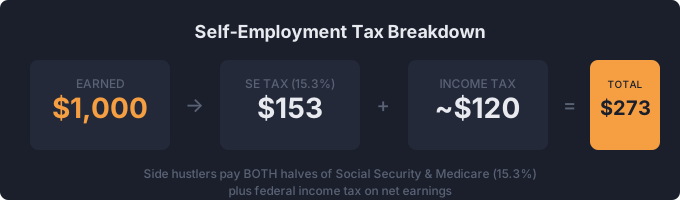
With side hustle income, you are both the employee and the employer. That means you pay both halves of Social Security and Medicare — a combined 15.3% self-employment tax — on top of your regular income tax rate. On $20,000 in side income, that is $3,060 in self-employment tax alone, before any income tax.
If you are in the 22% federal tax bracket, your total effective tax rate on side income is roughly 35–40% when you combine self-employment tax, federal income tax, and state income tax. On $1,500/month in side income, expect to owe approximately $525–$600/month in taxes. Most first-year side hustlers are shocked by this number because they spent the money before setting it aside.
Quarterly Estimated Tax Payments
The IRS expects you to pay taxes as you earn income — not just once a year in April. If you expect to owe $1,000 or more in taxes from your side hustle, you are required to make quarterly estimated payments. The deadlines are:
- Q1: April 15
- Q2: June 15
- Q3: September 15
- Q4: January 15 (of the following year)
Missing these deadlines results in an underpayment penalty, currently around 8% annualized. Use IRS Form 1040-ES to calculate your estimated payments, or simply set aside 30–40% of every payment you receive into a dedicated tax savings account.
Separate Your Side Hustle Money
The single most important system for managing side income is keeping it completely separate from your regular finances. Open a dedicated checking account for your side hustle. All income goes in. All business expenses come out. Tax savings transfer to a separate savings account.
This separation does three critical things. First, it makes tax time dramatically easier — your business transactions are already isolated. Second, it prevents you from accidentally spending money earmarked for taxes. Third, it gives you a clear picture of how much your side hustle actually earns after expenses.
Many online banks offer free business checking accounts with no minimum balance. The 15 minutes it takes to open one will save you hours of headaches at tax time and potentially thousands in penalties.
The 50/30/20 Split for Side Income
Your regular paycheck likely follows a traditional budget — housing, food, transportation, savings. Side hustle income should follow a different allocation because it carries different obligations. A practical split:
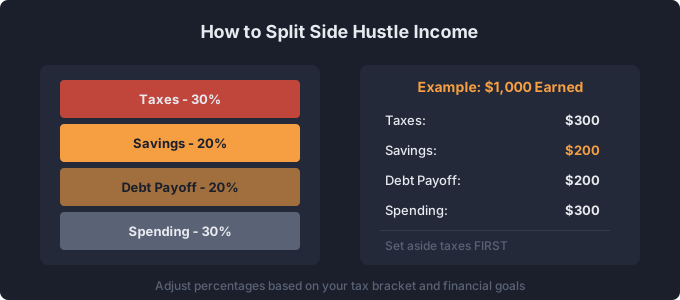
50% — Taxes and Savings. Set aside half of every dollar earned for taxes (30–40%) and long-term savings (10–20%). On $1,500/month in side income, that is $750 going straight into your tax and savings accounts. This percentage feels aggressive, but it accounts for self-employment tax, income tax, and building a buffer. If your actual tax bill is lower, the excess becomes additional savings.
30% — Debt Payoff or Financial Goals. Direct $450/month toward your highest-priority financial goal. If you have high-interest debt, this accelerates payoff dramatically. A $10,000 credit card balance at 24% APR paid with an extra $450/month is gone in 18 months instead of 6+ years at minimum payments. If you are debt-free, funnel this toward an emergency fund, down payment, or retirement contributions. Use a 50/30/20 budget calculator to model different scenarios.
20% — Spending or Reinvestment. The remaining $300/month is yours to spend guilt-free or reinvest in growing the side hustle. This is important — if you never enjoy any of the extra income, motivation dies. Whether you use it for dining out, a vacation fund, or better equipment for your side business, this portion keeps the hustle sustainable.
Tracking Income and Expenses
Every dollar that flows through your side hustle needs to be recorded. This is not optional — it is a legal requirement if you report self-employment income. At minimum, track:
- All income received — date, amount, client or source, payment method
- All business expenses — date, amount, category, business purpose
- Mileage — if you drive for your side hustle, log every trip (the 2026 IRS rate is $0.70/mile)
- Home office use — if you use a dedicated space, track square footage for the home office deduction
Common deductible expenses include software subscriptions, equipment, internet (business percentage), phone (business percentage), office supplies, professional development, and marketing costs. These deductions reduce your taxable income, which directly lowers your tax bill. A $500/month expense deduction in the 22% bracket saves you roughly $110/month in taxes.
When a Side Hustle Becomes a Business
The IRS draws a line between a hobby and a business. If your activity generates a profit in 3 out of 5 years, it is generally considered a business. Once you cross approximately $20,000–$30,000/year in revenue, it is worth considering a formal business structure.
A sole proprietorship is the default — you report income on Schedule C with no separate filing. An LLC ($50–$500 to form, depending on your state) provides liability protection and separates your personal assets from business risk. An S-Corp election becomes advantageous around $40,000–$50,000/year in net profit — it allows you to pay yourself a reasonable salary and take the rest as distributions, potentially saving $3,000–$6,000/year in self-employment tax.
Consult a tax professional when your side hustle consistently earns more than $2,000/month. The cost of a CPA ($200–$500 for a tax return) is a deductible business expense and typically saves far more than it costs.
Scaling vs. Maintaining
Not every side hustle needs to become a full-time business. There is real value in a steady $1,000–$2,000/month side income that requires 10–15 hours per week. Scaling means more income but also more complexity — employees, taxes, insurance, and time commitments that can rival a full-time job.
Before scaling, ask yourself: Is the goal to replace your full-time income, or to supplement it? If supplementing, optimize for efficiency — raise your rates, automate repetitive tasks, and drop low-paying clients. If replacing, build systems that allow the business to operate without your constant involvement. Track your effective hourly rate (total income divided by total hours worked). If it falls below $25–$30/hour after expenses and taxes, restructuring may be more valuable than scaling.
Track your side hustle subscriptions
Software, tools, and services add up. See exactly what your side hustle costs each month.
Open Free Subscription Tracker →Related tools
50/30/20 Budget Calculator — Model the ideal split for your side income
Debt Payoff Calculator — See how extra income accelerates debt freedom
Net Worth Calculator — Track your overall financial progress
Related guides
Paycheck Budgeting Guide — Manage your main income alongside side earnings
Subscription Audit Checklist — Cut unnecessary business and personal subscriptions