How to Set and Actually Reach a Savings Goal
March 2026 · 5 min read
This article is for informational purposes only and does not constitute financial advice. See our full disclaimer.
"I want to save money" is a wish. "I want to save $5,000 by December" is a goal. The difference is specificity — and specificity is what turns intention into action.
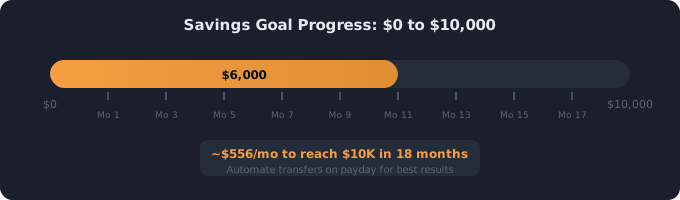
Step 1: Pick a number and a date
Use the savings goal calculator to find your exact monthly target. Enter your goal amount, current savings, and timeline — it calculates the rest, including compound interest if you're using a high-yield savings account.
Be specific. Instead of "save for a vacation," write down "$3,500 for a trip to Costa Rica by March 2027." Instead of "build an emergency fund," set the target at "$6,000 by December." A specific number and date let you calculate an exact monthly savings amount, which makes the goal feel achievable rather than abstract. If the monthly amount feels too high, extend the timeline or reduce the target until you find a number you can commit to.
Step 2: Find the money
Most people have $30-$50/month hiding in forgotten subscriptions. Run a quick subscription audit to find yours. Then check your budget split — if wants exceed 30%, that's where your savings are.
Here are concrete places to look: streaming services you rarely watch ($15-$45/month), a gym membership you have not used in weeks ($30-$60/month), premium app subscriptions you forgot about ($5-$15 each), and dining out more than twice a week ($100-$200/month in potential savings). You do not have to cut everything — even redirecting $75 per month from wasteful spending to savings adds up to $900 per year.
Step 3: Automate
Set up automatic transfers on payday. Money that moves before you see it doesn't feel like sacrifice. This is the single most effective savings strategy.
Most banks let you schedule recurring transfers for free. Set it for the same day your paycheck hits — if you get paid on the 1st and 15th, schedule a $75 transfer on each date. That is $150 per month ($1,800 per year) with zero effort after the initial setup. If your employer allows direct deposit splitting, that is even better: the money goes straight to savings without ever touching your checking account.
Step 4: Let compound interest help
Even a 4-5% high-yield savings account adds up. Use the compound interest calculator to see the difference over time.
If you save $200 per month in a high-yield savings account earning 4.5% APY, after 3 years you will have roughly $7,620 — about $420 more than if you stuffed cash in a drawer. Over 5 years, that same $200 per month becomes $13,320, with over $1,320 earned from interest alone. The interest is not life-changing on short timelines, but it is free money that accelerates your progress. For longer-term goals (5+ years), investment accounts can offer even higher returns. See our compound interest guide for a deeper look.
Popular savings goals
- Starter emergency fund ($1,000): $167/mo for 6 months or $84/mo for 12 months
- Full emergency fund ($6,000-$12,000): 3-6 months of expenses — the gold standard for financial security
- Vacation ($3,000): $250/mo for 12 months
- Used car ($8,000): $334/mo for 2 years
- Down payment ($20,000): $556/mo for 3 years
- Wedding ($15,000): $625/mo for 2 years
How much should you save each month?
The right savings rate depends on your income, expenses, and goals — but there are useful benchmarks to start from.
The 20% guideline: The popular 50/30/20 budget suggests putting 20% of your take-home pay toward savings and debt repayment. On a $3,500 monthly take-home, that is $700 per month. If you are currently saving nothing, jumping straight to 20% might feel impossible — and that is fine. Start where you can and increase over time.
The 1% ramp-up method: If 20% feels out of reach, start by saving 1% of your take-home pay this month. On a $3,500 paycheck, that is just $35. Next month, bump it to 2% ($70). Increase by 1% each month until you hit a number that feels sustainable. Most people can reach 10-15% within a year without feeling deprived, because the increases are so gradual they barely notice.
After debt: If you are aggressively paying down high-interest debt, aim for a minimum of $50-$100 per month in savings (for emergencies) while directing the rest toward debt. Once the debt is paid off, redirect those payments entirely to savings — you are already used to living without that money.
Short-term vs long-term savings goals
Not all savings goals should be treated the same way. The timeline determines where you keep the money and how much risk you can take.
Short-term goals (under 2 years)
Emergency funds, vacations, holiday budgets, and small purchases like electronics or furniture. These need to be liquid and safe — you cannot afford to lose 20% of your vacation fund to a market dip three months before the trip. Keep short-term savings in a high-yield savings account where the money is accessible within 1-2 business days and earning 4-5% APY.
Medium-term goals (2-5 years)
A car purchase, wedding fund, or down payment typically falls in this range. You have a bit more flexibility here. A high-yield savings account still works well, but you might also consider certificates of deposit (CDs) if you know the exact date you need the money. A 2-year CD might offer a slightly higher rate than a savings account in exchange for locking up your money. For example, $300 per month in a savings account at 4.5% for 3 years yields about $11,430. The same amount in a CD ladder could yield slightly more.
Long-term goals (5+ years)
Retirement, a child's education fund, or a future home purchase years away. For these goals, keeping money in a savings account actually loses value after inflation. Over 5+ years, broad market index funds have historically returned 7-10% annually — significantly more than any savings account. A $300 monthly investment at 8% average return becomes roughly $22,000 after 5 years and $58,000 after 10 years. The tradeoff is short-term volatility, but over long timelines the growth potential far outweighs the risk.
Where to put your savings
The right account depends on your goal timeline, risk tolerance, and how quickly you need access to the money.
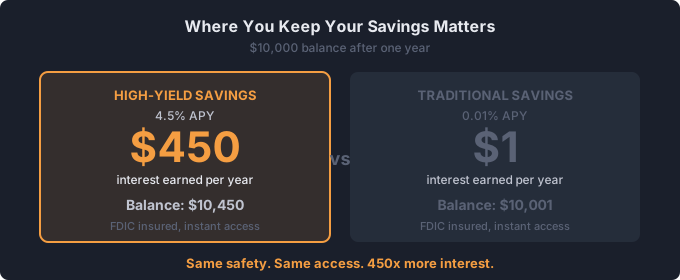
High-yield savings accounts (HYSAs)
Best for: emergency funds, short-term goals, and any money you might need quickly. In 2026, many online banks offer rates between 4.0-5.0% APY with no minimum balance and no fees. On a $5,000 balance, that is $200-$250 per year in interest — compared to roughly $5 in a traditional bank savings account at 0.1%. HYSAs are FDIC insured up to $250,000 and typically allow unlimited withdrawals.
Certificates of deposit (CDs)
Best for: money you will not need for a specific period (6 months to 5 years). CDs lock your money for a fixed term in exchange for a guaranteed rate. In 2026, 1-year CDs offer roughly 4.0-4.75% APY. The downside is early withdrawal penalties if you need the money before the term ends — typically 3-6 months of interest. A CD ladder (splitting your savings across CDs with staggered maturity dates) gives you both higher rates and periodic access to your money.
Investment accounts
Best for: long-term goals (5+ years) where you can ride out market fluctuations. A brokerage account invested in a total stock market index fund has historically averaged 7-10% annual returns over any 20-year period. For retirement specifically, tax-advantaged accounts like a 401(k) or IRA let your investments grow without annual tax drag. If your employer matches 401(k) contributions, that match is an immediate 50-100% return on your money — always contribute enough to get the full match before funding other goals.
Calculate your monthly savings target
Enter your goal and timeline to see exactly how much to save each month.
Open Savings Calculator →Related tools
Savings Goal Calculator · Compound Interest Calculator · Subscription Tracker