Index Funds Explained: Why They're Popular for Beginners
Published April 2026 · 9 min read
This article is for informational purposes only and does not constitute financial advice. See our full disclaimer.
If you have ever felt overwhelmed by investing, you are not alone. Picking individual stocks is time-consuming, risky, and stressful. That is exactly why index funds have become the most popular investment vehicle for beginners and experienced investors alike. They are simple, cheap, and historically effective. Warren Buffett has repeatedly recommended them as the single best investment most people can make.
This guide explains what index funds are, how they work, why their low fees create an enormous advantage over time, and exactly how to buy your first one.
What Is an Index Fund?
An index fund is a type of investment fund designed to track the performance of a specific market index. The most well-known index is the S&P 500, which includes 500 of the largest publicly traded companies in the United States, such as Apple, Microsoft, Amazon, and Johnson & Johnson. When you buy shares of an S&P 500 index fund, you are effectively buying a tiny piece of all 500 companies in a single transaction.
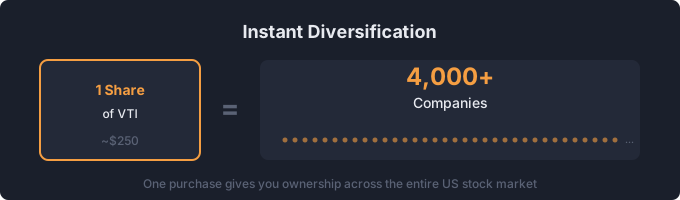
Other popular indexes include the Total Stock Market Index (which covers roughly 4,000 U.S. stocks, including small and mid-size companies), international indexes that track companies outside the U.S., and bond indexes that track the fixed-income market. The key idea is the same: instead of trying to pick winning stocks, you own the entire market, or a broad slice of it.
How Index Funds Work
When a fund company like Vanguard, Fidelity, or Schwab creates an index fund, they buy shares of every company in the target index, weighted by each company's size. If Apple represents 7% of the S&P 500 by market value, then 7% of the fund's holdings go to Apple stock. The fund manager does not try to pick the best stocks or time the market. They simply mirror the index.
This passive approach is the opposite of active management, where a fund manager researches companies, makes predictions, and trades frequently in an attempt to beat the market. Active management sounds appealing in theory, but the data tells a different story: over any 15-year period, roughly 90% of actively managed funds fail to beat their benchmark index. You are statistically better off owning the index itself.
Why Fees Matter More Than You Think
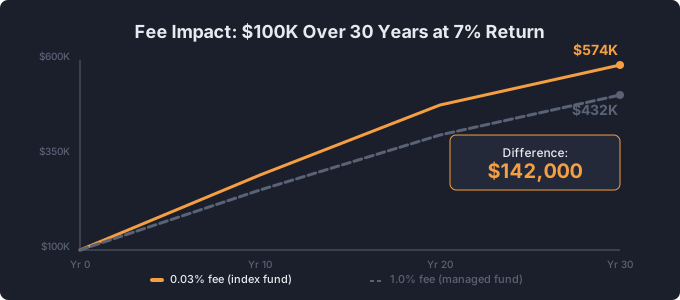
The most powerful advantage of index funds is their extremely low fees. Fund fees are expressed as an expense ratio, which is the percentage of your investment the fund charges annually. Here is the difference:
- Typical index fund expense ratio: 0.03% to 0.10%
- Typical actively managed fund expense ratio: 0.50% to 1.50%
That gap looks tiny in percentage terms, but the dollar impact over decades is staggering. Consider two investors who each invest $500 per month for 30 years and earn the same 10% average annual return before fees:
- Index fund (0.03% fee): Final balance of approximately $1,130,000
- Active fund (1.00% fee): Final balance of approximately $1,020,000
That 0.97% difference in fees costs you over $110,000 in lost growth. The money does not disappear — it goes to the fund company. By choosing a low-cost index fund, you keep that money compounding in your account instead. Use a compound interest calculator to model this with your own numbers.
Historical Returns
The S&P 500 has delivered an average annual return of roughly 10% per year over the past century, or about 7% after adjusting for inflation. This includes every crash, recession, and bear market along the way. No single year is guaranteed — the index has dropped as much as 38% in a bad year and gained over 30% in a good one. But investors who stayed invested over any 20-year rolling period in market history have never lost money.
This long-term consistency is what makes index funds ideal for goals that are years or decades away, such as retirement. The strategy works precisely because you do not try to predict short-term moves. You invest regularly, hold through volatility, and let compounding do the work.
Popular Index Funds to Consider
You do not need to spend hours researching funds. Here are the most widely held index funds, all of which track broad market indexes and charge minimal fees:
S&P 500 Index Funds
- VOO (Vanguard S&P 500 ETF) — Expense ratio: 0.03%. One of the largest and most liquid ETFs in existence.
- FXAIX (Fidelity 500 Index Fund) — Expense ratio: 0.015%. A mutual fund version available through Fidelity accounts.
- SWPPX (Schwab S&P 500 Index Fund) — Expense ratio: 0.02%. Available through Charles Schwab.
Total Market Index Funds
- VTI (Vanguard Total Stock Market ETF) — Expense ratio: 0.03%. Covers the entire U.S. stock market, roughly 4,000 companies including small caps.
- FSKAX (Fidelity Total Market Index Fund) — Expense ratio: 0.015%. Fidelity's equivalent total market fund.
Any of these funds will give you broad diversification at rock-bottom cost. The differences between them are negligible for most investors. Pick whichever is available through your brokerage account.
How to Buy Your First Index Fund
Getting started is simpler than most people expect. Here is the process step by step:
1. Open a brokerage account. If you do not already have one, open an account at Vanguard, Fidelity, Schwab, or any major broker. If your employer offers a 401(k), check whether it includes index fund options — many do, and you may get matching contributions.
2. Decide how much to invest. You do not need thousands of dollars. Most brokerages allow you to buy fractional shares, meaning you can start with as little as $1. A common approach is to invest a fixed amount from each paycheck, which is known as dollar-cost averaging.
3. Search for the fund. Type the ticker symbol (VOO, VTI, FXAIX, etc.) into your brokerage's search bar. Review the fund details to confirm the expense ratio and index it tracks.
4. Place the order. For ETFs like VOO or VTI, you place a market order just like buying a stock. For mutual funds like FXAIX, you enter a dollar amount and the purchase executes at the end of the trading day.
5. Set up automatic investing. Most brokerages let you schedule recurring purchases — weekly, biweekly, or monthly. Automation removes the temptation to time the market and ensures you invest consistently.
The Set-and-Forget Strategy
The greatest advantage of index fund investing is that it requires almost no ongoing effort. Once you set up automatic contributions to a broad index fund, your primary job is to not interfere. Do not sell during downturns. Do not chase hot stocks. Do not check your balance daily.
Research consistently shows that investors who trade frequently earn lower returns than those who buy and hold. The set-and-forget approach works because it eliminates emotional decision-making, which is the single biggest destroyer of investment returns for individual investors.
Review your allocation once or twice a year to make sure it still matches your goals and risk tolerance. As you get closer to retirement, you may want to shift some money from stock index funds into bond index funds for stability. But the core strategy stays the same: own the market, keep costs low, and let time work in your favor.
See how compounding grows your money
Model index fund growth with different contribution amounts. Free, instant results.
Open Compound Interest Calculator →Related tools
Compound Interest Calculator — See how your investments grow over time
Savings Goal Calculator — Figure out how much to invest each month
Net Worth Calculator — Track your investments alongside all assets
Related guides
Compound Interest Explained — The math behind exponential growth
Savings Goal Guide — Set and reach your financial targets