20 Ways to Reduce Your Monthly Expenses
Published April 2026 · 11 min read
This article is for informational purposes only and does not constitute financial advice. See our full disclaimer.
Most people do not have an income problem — they have an expense problem. The average American household spends $6,440 per month, and a meaningful chunk of that goes to costs that can be reduced or eliminated without a noticeable change in quality of life. Small adjustments across multiple categories add up fast.
Below are 20 specific, actionable ways to cut your monthly spending, organized by category. Each tip includes an estimated monthly savings range so you can prioritize the moves that matter most for your situation.
Housing ($100–$400/month)
1. Refinance your mortgage. If your current rate is more than 1% above today's rates, refinancing a $300,000 loan could save $150–$300/month. Even with closing costs of $3,000–$6,000, the break-even point is typically 12–18 months. Check current rates quarterly.
2. Get a roommate. Splitting a $1,800/month apartment saves $900/month. Even renting out a spare bedroom in a home you own can bring in $500–$800/month depending on your market. This single move often has the biggest impact of anything on this list.
3. Negotiate your rent. Landlords would rather keep a reliable tenant than face a vacancy. Before your lease renewal, research comparable units in your area and ask for a reduction or a freeze. Success rate is surprisingly high — roughly 40% of renters who ask get some form of concession, saving $50–$150/month on average.
Transportation ($80–$250/month)
4. Drive less. The IRS mileage rate is $0.70 per mile in 2026, reflecting the true cost of driving. Cutting 200 miles per month (one fewer errand trip per week, carpooling twice a week) saves $140/month in gas, wear, and depreciation. Combine errands into single trips and explore remote work options.
5. Stay on top of car maintenance. Properly inflated tires improve fuel economy by 3%. A clean air filter improves it by up to 10%. Regular oil changes prevent expensive engine repairs. Budget $100/month for maintenance to avoid $2,000–$5,000 surprise repair bills. Net savings: $30–$60/month in fuel alone.
6. Shop auto insurance annually. Rates vary wildly between carriers for the same coverage. Getting three to five quotes each year typically saves $50–$100/month. Loyalty rarely pays — new customer discounts often beat renewal rates by 15–25%.
Food ($150–$300/month)
7. Meal plan every week. Families that meal plan spend 20–30% less on groceries than those who do not. For a household spending $800/month on food, that is $160–$240/month in savings. Spend 20 minutes on Sunday planning the week's meals and building a shopping list.
8. Cook at home. The average restaurant meal costs $15–$20 per person compared to $4–$6 for a home-cooked meal. Replacing just four restaurant meals per month with home cooking saves a couple $80–$120/month. Batch cooking on weekends makes weeknight meals as convenient as takeout.
9. Buy in bulk strategically. Non-perishable staples — rice, pasta, canned goods, cleaning supplies — cost 20–40% less in bulk. A warehouse club membership ($60/year) pays for itself in 2–3 trips. Estimated savings: $40–$80/month for a family. Avoid bulk buying perishables unless you have a plan to use them.
Subscriptions ($50–$150/month)
10. Audit every subscription. The average person spends $84/month on subscriptions and underestimates the total by 40%. Use a subscription tracker to list every recurring charge. Most people find $30–$50/month in services they forgot about or no longer use. Cancel anything you have not used in the past 30 days.
11. Downgrade to ad-supported plans. Switching from ad-free to ad-supported tiers on streaming services saves $5–$10 per service. Across Netflix, Hulu, and Disney+, that is $15–$30/month. Most ad-supported plans show 4–5 minutes of ads per hour — a minor trade-off for significant savings.
12. Rotate streaming services. Instead of subscribing to four or five streaming services simultaneously at $60–$80/month, subscribe to one at a time and rotate monthly. Watch what you want, cancel, and switch. You will spend $15–$18/month instead — savings of $45–$62/month.
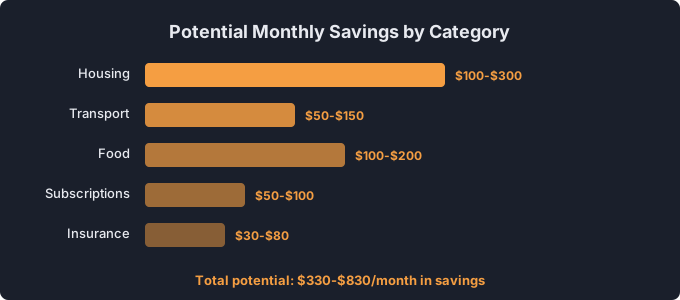
Insurance ($40–$120/month)
13. Bundle home and auto insurance. Most insurers offer a 10–25% multi-policy discount. On combined premiums of $400/month, bundling saves $40–$100/month. Get quotes from at least three carriers to find the best bundle rate.
14. Increase your deductibles. Raising your auto insurance deductible from $250 to $1,000 can lower premiums by 15–30%. On a $150/month policy, that saves $22–$45/month. Make sure you have the higher deductible amount in savings before making this switch.
15. Shop insurance annually. Like auto insurance, homeowners and renters insurance rates vary widely. An annual comparison across three to five carriers typically saves $20–$50/month. Set a calendar reminder to shop every year at renewal time.
Utilities ($30–$80/month)
16. Switch to LED bulbs. Replacing 20 incandescent bulbs with LEDs saves approximately $10–$15/month on electricity. LEDs last 25 times longer, so replacement costs drop too. This is one of the easiest one-time changes with permanent savings.
17. Install a programmable thermostat. A smart thermostat that adjusts temperature when you are away or sleeping saves $10–$25/month on heating and cooling. The device costs $25–$250 and pays for itself within 2–6 months.
18. Weatherize your home. Sealing air leaks around windows, doors, and outlets costs $50–$200 in materials and saves $15–$40/month in heating and cooling. Adding attic insulation is a bigger project ($1,000–$2,500) but can save $30–$50/month year-round.
Shopping Habits ($50–$100/month)
19. Use the 30-day rule. Before any non-essential purchase over $50, wait 30 days. If you still want it after a month, buy it. Studies show that 70% of impulse purchases are never completed when a waiting period is enforced. On average, this saves $50–$100/month in avoided impulse spending.
20. Use cash-back apps and credit cards. Cash-back credit cards return 1.5–5% on purchases you are already making. On $2,000/month in spending, that is $30–$100/month back. Stack this with apps like Rakuten or Ibotta for additional savings on groceries and online shopping. Just make sure you pay the full balance every month — interest charges erase all cash-back benefits.
Adding It All Up
You do not need to implement all 20 strategies. Most households can realistically adopt 8–12 of these tips and see savings of $500–$1,000 per month. That is $6,000–$12,000 per year — enough to fund an emergency fund, max out a Roth IRA, or pay off a significant chunk of debt.
The biggest wins typically come from housing (roommate or refinance), food (meal planning and cooking at home), and subscriptions (auditing and rotating). Start with the categories where you are currently overspending the most, then work your way through the list over 2–3 months.

Start with your subscriptions
Most people find $30–$50/month in forgotten recurring charges. Audit yours in 2 minutes.
Open Free Subscription Tracker →Related tools
50/30/20 Budget Calculator — See how your expenses fit the recommended budget split
Paycheck Budget Calculator — Allocate every dollar of your paycheck
Debt Payoff Calculator — Put your savings toward paying off debt faster
Related guides
Subscription Audit Checklist — 15-minute walkthrough to cut subscription costs
Paycheck Budgeting Guide — Make the most of every paycheck