Financial Goals by Age: Milestones for Your 20s, 30s, 40s, and Beyond
Published April 2026 · 10 min read
This article is for informational purposes only and does not constitute financial advice. See our full disclaimer.
Personal finance is not one-size-fits-all, but there are clear milestones that apply to most people at each stage of life. Whether you are just starting your career or approaching retirement, having concrete dollar targets helps you measure progress and stay motivated. This guide breaks down the most important financial goals decade by decade, with real numbers you can aim for.
The key principle: every decade builds on the one before it. Missing a milestone in your 20s does not mean you are out of luck — it means your 30s need to work harder. The earlier you start, the more compound interest works in your favor.
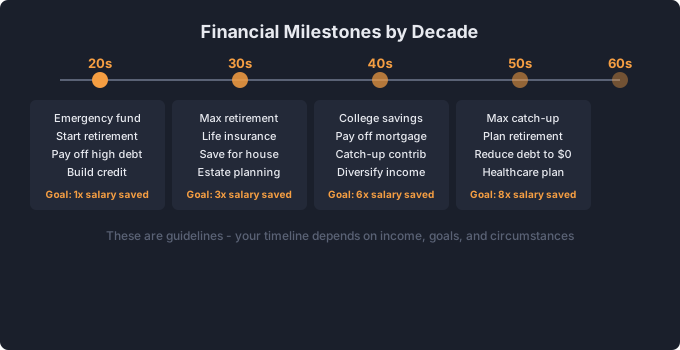
Your 20s: Build the Foundation
Your 20s are about establishing habits, not accumulating wealth. The money moves you make now — even small ones — have the longest runway to compound. A single dollar invested at age 22 is worth roughly $10–$15 by age 65 assuming average market returns. That same dollar invested at 35 is worth only $4–$6.
Build a $1,000 Starter Emergency Fund
Before anything else, put $1,000 into a high-yield savings account. This is not your full emergency fund — it is a buffer that prevents you from going into debt for minor emergencies like a car repair or medical copay. Once you have it, grow it to 3 months of expenses (typically $4,500–$7,500 for most 20-somethings).
Start Retirement Contributions Immediately
If your employer offers a 401(k) match, contribute at least enough to get the full match — that is an instant 50–100% return on your money. The most common match is 50% of contributions up to 6% of your salary. On a $45,000 salary, that means contributing $2,700/year and receiving $1,350 free from your employer. If you do not have an employer plan, open a Roth IRA and contribute even $100/month. By age 30, aim to have saved $30,000–$50,000 for retirement.
Pay Off High-Interest Debt
Credit card debt averaging 22–28% APR is a financial emergency. No investment consistently returns that rate. Prioritize paying off any balance over 10% interest before increasing retirement contributions beyond the employer match. The average American in their 20s carries $5,200 in credit card debt — eliminating that saves $1,200–$1,400 per year in interest alone.
Build Your Credit Score
A credit score above 740 qualifies you for the best interest rates on mortgages, auto loans, and insurance. In your 20s, this means using one or two credit cards responsibly, paying the full balance every month, and keeping utilization below 30%. The difference between a 680 and a 760 credit score on a 30-year mortgage can save you $40,000–$60,000 in interest over the life of the loan.
Your 30s: Accelerate and Protect
Your 30s are when financial complexity increases — higher income, possibly a partner, kids, and homeownership all enter the picture. This is the decade where good habits start producing visible results.
Save 1x Your Salary for Retirement
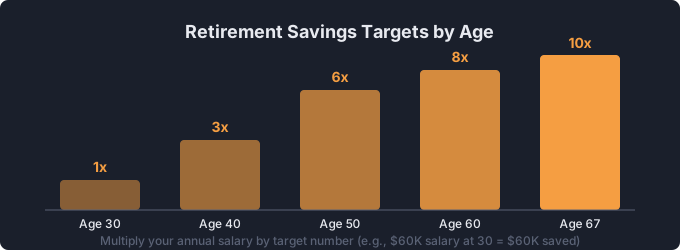
By age 30, the standard benchmark is having one times your annual salary saved for retirement. If you earn $60,000, you should have $60,000 in retirement accounts. By 35, aim for 2x your salary. This sounds aggressive, but consistent contributions plus market growth make it achievable if you started in your 20s.
Save for a Down Payment
If homeownership is a goal, you need 10–20% of the purchase price saved for a down payment, plus 2–5% for closing costs. On a $350,000 home, that is $35,000–$70,000 for the down payment alone. Start a dedicated savings account and automate transfers. A 20% down payment eliminates private mortgage insurance (PMI), saving you $100–$200/month.
Get Life Insurance
If anyone depends on your income — a spouse, children, or aging parents — you need term life insurance. A healthy 30-year-old can get a $500,000, 20-year term policy for $25–$35/month. Waiting until 40 can double that cost. The general rule is coverage of 10–12x your annual income.
Increase Your Income
Your 30s are prime earning growth years. The median salary increase from age 25 to 35 is roughly 40–55%. Negotiate raises aggressively, pursue promotions, and consider side income. Every $10,000 raise that goes directly into investing adds approximately $200,000–$300,000 to your retirement portfolio over 25 years.
Your 40s: Peak Earnings, Peak Responsibility
For most workers, the 40s represent the highest earning decade. It is also when retirement stops feeling distant and starts feeling real. The decisions you make here have the most direct impact on your retirement date.
Save 3x Your Salary for Retirement
By age 40, you should have approximately 3 times your annual salary in retirement accounts. On a $90,000 salary, that is $270,000. By 45, the target moves to 4x. If you are behind, this is the last decade where aggressive catch-up is realistic without major lifestyle changes.
Maximize Retirement Contributions
In 2026, the 401(k) contribution limit is $23,500, and the IRA limit is $7,000. If both spouses max out a 401(k) and an IRA, a household can shelter $61,000/year in tax-advantaged retirement accounts. If your income is at its peak, this is the time to push contributions as high as possible.
Start College Planning
If you have children, a 529 plan offers tax-free growth for education expenses. The average cost of a 4-year public university is projected to be $120,000–$160,000 for today's toddlers. Contributing $300/month to a 529 starting at birth can cover roughly $80,000–$100,000 of that bill. Starting at age 10 requires $700–$900/month for the same result.
Review Insurance and Estate Documents
Update your will, designate beneficiaries, and consider an umbrella insurance policy ($1–2 million for $200–$400/year). If your net worth has grown substantially, consult an estate planning attorney about trusts and tax-efficient transfer strategies.
Your 50s: The Final Push
Your 50s are defined by two forces: catch-up contributions become available, and retirement planning shifts from abstract to concrete. This is the decade to finalize your retirement number and make a plan for healthcare.
Save 6x Your Salary for Retirement
By age 50, the target is 6 times your annual salary. By 55, it should be 7x. On a $100,000 salary, that means $600,000–$700,000. If you are behind, take advantage of catch-up contributions: an extra $7,500/year in your 401(k) and an extra $1,000/year in your IRA starting at age 50.
Plan for Medicare and Healthcare
Medicare begins at 65, but if you retire before then, you need a bridge strategy. COBRA coverage lasts 18 months. ACA marketplace plans can cost $500–$1,200/month for a couple in their late 50s. Many financial plans fail because they underestimate healthcare costs — the average retired couple spends $315,000 on healthcare over their lifetime.
Consider Downsizing
If the kids have moved out, a smaller home can free up significant equity. Selling a $400,000 home and buying a $250,000 home puts $100,000–$130,000 (after costs) back into your portfolio. Lower housing costs also reduce ongoing monthly expenses by $500–$1,000.
Your 60s and Beyond: Protect and Distribute
The transition from saving to spending is one of the hardest shifts in personal finance. Your 60s are about making smart decisions on Social Security timing, withdrawal sequencing, and sustainable spending rates.
Optimize Social Security Timing
You can claim Social Security as early as 62, but every year you delay until 70 increases your benefit by roughly 8%. On an average benefit of $1,900/month at 67 (full retirement age), waiting until 70 increases it to approximately $2,356/month — an extra $5,472/year for life. Claiming at 62 reduces it to about $1,330/month. For most people with other savings, delaying is the better mathematical choice.
Plan Your Withdrawal Strategy
The 4% rule suggests withdrawing 4% of your portfolio in year one, then adjusting for inflation. On a $1,000,000 portfolio, that is $40,000/year. Combined with Social Security, most retirees need a portfolio that can sustain $20,000–$50,000 in annual withdrawals. Withdraw from taxable accounts first, then traditional retirement accounts, and let Roth accounts grow tax-free as long as possible.
Review Beneficiaries and Estate Plans
Update all beneficiary designations on retirement accounts, life insurance, and bank accounts. These designations override your will, so they must be current. An estimated $1.5 trillion will transfer between generations over the next decade — proper planning ensures your assets go where you intend.
See where you stand today
Track your subscriptions and recurring expenses to free up money for your financial goals.
Open Free Subscription Tracker →Related tools
Net Worth Calculator — Measure your progress at any age
Savings Goal Calculator — Plan for down payments, emergency funds, and more
Compound Interest Calculator — See how time multiplies your money
Related guides
Savings Goal Guide — Step-by-step plan to reach any savings target
Compound Interest Explained — Understand the force behind long-term wealth