The Envelope Budgeting Method Explained
Published April 2026 · 8 min read
This article is for informational purposes only and does not constitute financial advice. See our full disclaimer.
The envelope budgeting method is one of the oldest and most effective ways to control spending. The concept is dead simple: you divide your cash into labeled envelopes for each spending category, and when an envelope is empty, you stop spending in that category. No spreadsheets, no apps, no complicated formulas — just a physical barrier between you and overspending.
While it started as a purely cash-based system, the envelope method has evolved into a budgeting philosophy that works just as well with digital tools. Whether you use actual envelopes or a budgeting app, the core principle remains the same: give every dollar a job before you spend it.
A Brief History of Envelope Budgeting
The envelope system dates back to the early 1900s when most workers were paid in cash. Families would literally divide their pay into envelopes labeled for rent, groceries, utilities, and savings. If the grocery envelope ran out mid-week, the family ate whatever was already in the pantry.
The method gained mainstream popularity through personal finance educators who recognized that the physical act of handing over cash creates a psychological spending barrier that credit and debit cards eliminate. Research supports this: studies consistently show that people spend 12–18% more when paying with cards compared to cash. The envelope method forces you to feel every purchase.
How It Works: Step by Step
Step 1: Calculate Your Monthly Take-Home Pay
Start with the money that actually hits your bank account after taxes, retirement contributions, and health insurance. This is the total amount you have available to allocate. If your income varies month to month, use the average of your last three months or the lowest recent month to be conservative.
Step 2: List Your Spending Categories
Write down every category where you spend money. Fixed expenses like rent, car payments, and insurance typically get paid by check or auto-pay and do not need physical envelopes. Focus your envelopes on variable spending — the categories where overspending actually happens.
Step 3: Assign Dollar Amounts to Each Envelope
Based on your income and past spending, decide how much goes into each envelope. Here is a realistic example for a household earning $4,200/month after taxes:
- Groceries: $400
- Dining out: $150
- Gas/transportation: $120
- Entertainment: $100
- Clothing: $75
- Personal care: $50
- Subscriptions: $60
- Miscellaneous: $75
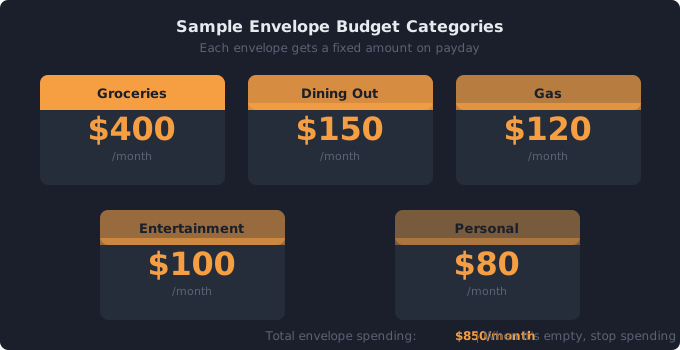
That totals $1,030 in envelope categories. The remaining $3,170 covers fixed expenses (rent, utilities, insurance, debt payments) and savings.
Step 4: Fill the Envelopes on Payday
On payday, withdraw cash and distribute it into your envelopes. If you are paid biweekly, split each envelope amount in half and fill them twice per month. Label each envelope clearly and keep them somewhere accessible but secure.
Step 5: Spend Only From the Right Envelope
When you buy groceries, the money comes from the grocery envelope. When you eat out, it comes from dining. When an envelope is empty, you have two choices: stop spending in that category until next month, or borrow from another envelope — knowing that the other category will come up short.
Digital Alternatives to Physical Envelopes
Carrying cash is not practical for everyone, and many purchases now happen online. Fortunately, the envelope concept translates well to digital tools.
Budgeting apps: Apps like YNAB (You Need a Budget), Goodbudget, and EveryDollar are built specifically around the envelope philosophy. They let you create virtual envelopes, assign money to each one, and track spending against those limits in real time.
Multiple bank accounts: Some people open separate checking or savings accounts for each major category. Your paycheck gets split via direct deposit into each account. This creates the same hard boundary as physical envelopes — when the dining account hits zero, dining out stops.
Spreadsheet tracking: A simple spreadsheet with columns for each category works if you are disciplined about logging purchases. Track your remaining balance in each category after every transaction.
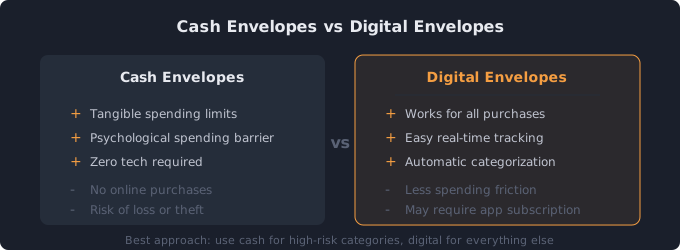
Prepaid debit cards: Load a prepaid card with your grocery budget, another with your entertainment budget, and so on. When the card is empty, you are done spending in that category.
Pros and Cons of Envelope Budgeting
The Advantages
Prevents overspending. The hard limit is the entire point. You physically cannot spend more than what is in the envelope, which eliminates the slow creep of untracked purchases that derails most budgets.
Simple to understand. There is no learning curve. Anyone can label envelopes and put money in them. This makes it one of the best budgeting methods for beginners or for couples who need a system they can both follow without debate.
Creates spending awareness. Watching your envelope balance decrease throughout the month makes every purchase feel real. This psychological effect is powerful — people who use the envelope method report being significantly more mindful about discretionary spending.
Works on any income. Whether you earn $2,000 or $10,000 per month, the system scales. You simply adjust the amounts. It is equally effective for low-income households trying to stretch every dollar and high earners who overspend because they assume they can afford it.
The Drawbacks
Carrying cash is risky and inconvenient. Cash can be lost, stolen, or simply awkward to use for large purchases. Online shopping requires a workaround since you cannot hand cash to a website.
Does not handle irregular expenses well. Car repairs, medical bills, and annual insurance premiums do not fit neatly into monthly envelopes. You need a separate system — typically a sinking fund — for these expenses.
Requires discipline to maintain. The system only works if you actually follow it. Borrowing from one envelope to cover another defeats the purpose, and it is tempting to do so when the entertainment envelope runs dry with two weeks left in the month.
Who It Works Best For
The envelope method is particularly effective for people who consistently overspend in specific categories, visual and tactile learners who benefit from physically seeing money leave their hands, couples who argue about spending because it creates clear agreed-upon limits, anyone recovering from debt who needs strict guardrails, and people who have tried app-based budgeting without success.
It is less ideal for people with highly variable income, frequent travelers, or those who do most of their spending online. In those cases, a digital adaptation of the envelope method — using a budget calculator to set category limits and a subscription tracker to monitor recurring charges — delivers the same benefits without the cash requirement.
Modern Adaptations That Keep It Relevant
The envelope method has survived for over a century because the underlying principle is timeless: spending limits work. Modern adaptations make it more practical than ever. Combine physical envelopes for your highest-risk categories (dining and entertainment tend to be the biggest budget busters) with digital tracking for everything else. Use auto-pay for fixed bills so they never touch your envelope system. And review your envelope amounts monthly — if you consistently have money left in one category and run out in another, adjust the allocations rather than fighting against reality.
The goal is not perfection. It is awareness and control. Any system that makes you think before you spend is already doing its job.
Track your subscriptions and recurring bills
Know exactly how much leaves your account each month before you set your envelope amounts.
Open Free Subscription Tracker →Related tools
50/30/20 Budget Calculator — Another popular budgeting framework
Paycheck Budget Calculator — Plan your envelope amounts around payday
Subscription Tracker — See all recurring charges in one place
Related guides
Paycheck Budgeting Guide — Budget by paycheck instead of by month
Savings Goal Guide — Set and reach your savings targets