Compound Interest Explained Simply
March 2026 · 5 min read
This article is for informational purposes only and does not constitute financial advice. See our full disclaimer.
Compound interest is the most powerful force in personal finance. It's why someone starting at 25 can end up with twice as much as someone starting at 35.
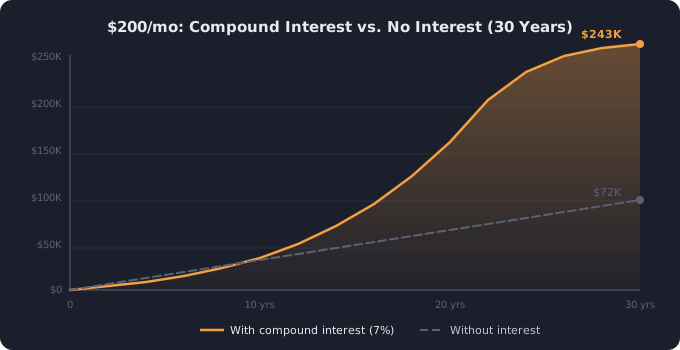
Simple vs compound interest
Simple interest: $1,000 at 5% = $50/year forever. After 30 years: $2,500. Compound interest: same $1,000 at 5% = $4,322 after 30 years. The difference grows dramatically with time.
Here is why that gap matters so much. With simple interest, your $1,000 only ever earns interest on the original amount. Year after year, it is the same $50. With compound interest, each year's interest gets added to your balance, and the next year you earn interest on the new, larger amount. In year one, you earn $50. In year two, you earn $52.50. By year 20, you are earning over $126 per year on that same original $1,000 — and by year 30, your annual interest payment is over $206. The snowball effect accelerates the longer you leave your money alone.
The 10-year head start
- Start at 25: $200/mo at 7% → $525,000 at 65 (contributed $96K)
- Start at 35: $200/mo at 7% → $243,000 at 65 (contributed $72K)
- Start at 45: $200/mo at 7% → $101,000 at 65 (contributed $48K)
$24K more contributed, $282K more in the account. That's compound interest. The person who started at 25 contributed only $24,000 more than the person who started at 35, but ended up with $282,000 more. And compared to the person who started at 45, the early starter contributed $48,000 more but ended up with $424,000 more. Time is the most important variable in the compound interest equation — not the dollar amount. Try different scenarios with the compound interest calculator.
The Rule of 72
Want a quick way to estimate how long it takes your money to double? Divide 72 by your annual interest rate. That gives you the approximate number of years to double your investment.
- At 4% (high-yield savings): 72 / 4 = 18 years to double
- At 7% (index funds): 72 / 7 = ~10.3 years to double
- At 10% (aggressive growth): 72 / 10 = 7.2 years to double
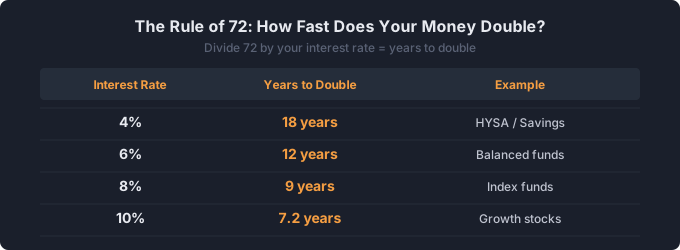
This means $10,000 invested in an index fund averaging 7% returns would become roughly $20,000 in about 10 years, $40,000 in 20 years, and $80,000 in 30 years — without adding a single extra dollar. Each doubling period builds on the last, which is why the growth curve feels slow at first and explosive later. The Rule of 72 also works in reverse: at 20% credit card interest, your debt doubles in just 3.6 years if you make no payments.
Where it works for you
High-yield savings (4-5% in 2026), index funds (~7-10% historically), retirement accounts (tax-advantaged compounding). Start with whatever you can — even $50/month. Find that first $50 by canceling a subscription you don't use.
Compound interest working against you
Credit card debt compounds too — against you. A $5,000 balance at 20% APR costs $8,000+ in interest if you pay minimums. Use the debt payoff calculator to see the true cost.
Credit cards are the most common example, but they are not the only one. Student loans, auto loans, and personal loans all use compounding — and the higher the rate, the faster the balance grows when you are only making minimum payments.
Credit cards: the worst offender
Most credit cards compound interest daily, not monthly or annually. That means a $5,000 balance at 22% APR (common in 2026) does not just cost you $1,100 per year in interest. Because interest compounds on itself daily, the effective annual cost is closer to $1,230. If you only make the minimum payment of $100 per month, it takes over 9 years to pay off that $5,000 — and you pay roughly $6,400 in total interest. You end up paying more than double the original balance.
Student loans add up quietly
Federal student loans typically carry rates between 5-8%. A $30,000 student loan balance at 6.5% on the standard 10-year repayment plan costs about $11,400 in interest over the life of the loan. But if you extend repayment to 20 years through income-driven plans, that interest cost can balloon to $24,000 or more. The longer the repayment timeline, the more compounding works against you.
The priority: eliminate high-interest debt first
If you have credit card debt at 20%+ interest, paying it off is the single best financial return you can get. No savings account or index fund reliably returns 20% per year. Every extra dollar you put toward high-interest debt is earning you that rate of return, guaranteed. Use the debt payoff calculator to build a paydown plan.
How to maximize compound interest
Once you understand how compounding works, the strategy is straightforward. Four factors determine how much you end up with: time, consistency, leaving your money alone, and compounding frequency.
Start as early as possible
This is the single most important factor. A 22-year-old investing $150 per month at 7% will have about $537,000 at age 65. A 32-year-old investing $300 per month — twice as much — at the same rate will have about $489,000. Starting earlier with less money beats starting later with more money, because those extra years of compounding are irreplaceable.
Contribute consistently
Sporadic investing works, but consistent monthly contributions dramatically improve outcomes. Setting up an automatic transfer of $200 on payday removes the temptation to skip a month. Over 30 years at 7%, missing just 12 months of contributions costs you roughly $25,000 in final balance — not $2,400 (the amount you skipped), but $25,000 in lost compounding.
Do not withdraw early
Every time you pull money out of a compounding account, you lose not just that money but all the future growth it would have generated. Withdrawing $5,000 from a retirement account at age 30 does not cost you $5,000. At 7% growth, that $5,000 would have become roughly $57,000 by age 65. Early withdrawals from retirement accounts also typically carry a 10% penalty plus income taxes, making them even more costly.
Higher compounding frequency helps
Interest can compound annually, monthly, daily, or even continuously. The more frequently it compounds, the more you earn. A $10,000 deposit at 5% compounded annually yields $16,289 after 10 years. The same deposit compounded daily yields $16,487 — an extra $198. The difference is small on short time horizons, but it grows over decades. High-yield savings accounts typically compound daily, which is one reason they outperform traditional savings accounts even at the same stated rate.
See how your money can grow
Try different amounts and time periods to visualize compound interest.
Open Compound Interest Calculator →Related tools
Compound Interest Calculator · Savings Goal Calculator · Net Worth Calculator