Your Annual Financial Checkup: A Complete Checklist
Published April 2026 · 10 min read
This article is for informational purposes only and does not constitute financial advice. See our full disclaimer.
Most people think about their finances only when something goes wrong: an unexpected bill, a declined card, a tax surprise. But the most effective financial habit is also one of the simplest — sitting down once a year for a thorough review of where you stand. Think of it as an annual physical for your money. It takes less than an hour, costs nothing, and consistently surfaces problems before they become expensive.
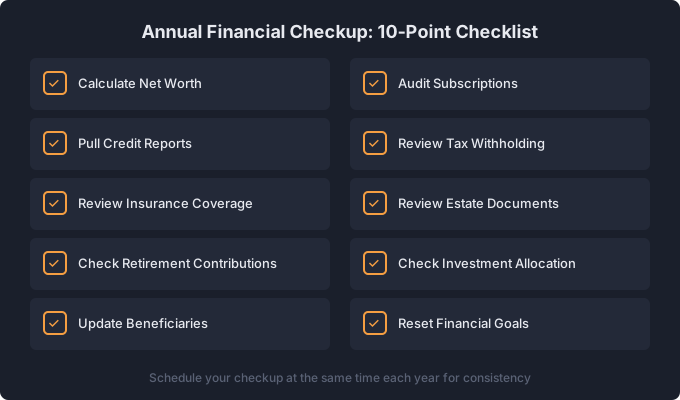
The best time to do your financial checkup is January (fresh start, tax documents arriving) or your birthday (easy to remember, naturally reflective). Pick one and put it on your calendar every year. Here are the 10 items to review.
1. Calculate Your Net Worth
Your net worth is the single most important number in personal finance. It is the sum of everything you own (assets) minus everything you owe (liabilities). Assets include bank accounts, investment accounts, retirement funds, home equity, and the value of any property. Liabilities include mortgages, student loans, car loans, credit card balances, and any other debt.
Write it all down and calculate the total. The number itself matters less than the direction — is your net worth higher than it was last year? If it is growing, your financial habits are working. If it is shrinking or stagnant, something needs to change. Use a net worth calculator to make this process quick and repeatable year over year.
2. Pull Your Credit Reports
You are entitled to a free credit report from each of the three major bureaus — Equifax, Experian, and TransUnion — every year through AnnualCreditReport.com. Pull all three during your checkup and review them for errors: wrong account balances, accounts you do not recognize, incorrect personal information, or negative marks that should have aged off.
Credit report errors are more common than most people realize. Studies have found that roughly one in four consumers have at least one error on their reports that could affect their credit score. Disputing and correcting these errors is free and can meaningfully improve your borrowing terms for mortgages, auto loans, and credit cards.
3. Review Your Insurance Coverage
Life changes fast, and your insurance needs change with it. During your checkup, review all active policies: health, auto, homeowners or renters, life, disability, and umbrella. Ask yourself whether your coverage still matches your current situation. Did you get married, have a child, buy a home, or change jobs this year? Each of these events may require adjusting your coverage levels or adding new policies.
Also compare premiums. Insurance rates vary significantly between carriers, and loyalty rarely gets rewarded with lower prices. Getting quotes from two or three competitors takes 20 minutes and can save $300 to $800 per year on auto and home insurance combined.
4. Check Your Retirement Contributions
Are you contributing enough to your 401(k) or IRA? At minimum, you should contribute enough to capture your employer's full match — anything less is leaving free money on the table. In 2026, the 401(k) contribution limit is $23,500 ($31,000 if you are 50 or older), and the IRA limit is $7,000 ($8,000 if 50+).
If you got a raise this year, increase your contribution percentage to match. A common strategy is to direct at least half of any raise toward retirement savings. You will barely notice the difference in your paycheck, but the compounding effect over decades is enormous. Even a 1% increase in your contribution rate can add tens of thousands of dollars to your retirement balance over 20 years.
5. Update Your Beneficiaries
Beneficiary designations on retirement accounts, life insurance policies, and bank accounts override your will. This means if your 401(k) still lists an ex-spouse as the beneficiary, that person will receive the money regardless of what your will says. Review the beneficiary on every financial account during your checkup and update any that are outdated.
This is one of the most frequently overlooked items in personal finance. Major life events like marriage, divorce, the birth of a child, or the death of a family member all warrant an immediate beneficiary update. Your annual checkup is the safety net that catches anything you missed.
6. Audit Your Subscriptions
The average American spends over $1,000 per year on subscriptions, and most people underestimate their total by 40% or more. Your annual checkup is the perfect time to pull up your bank and credit card statements, identify every recurring charge, and decide which subscriptions still deliver enough value to justify their cost.
Look for charges between $2 and $20 — these small amounts fly under the radar but add up fast. Common culprits include forgotten app store subscriptions, free trials that converted to paid plans, and services you signed up for months ago and no longer use. A typical audit uncovers $30 to $50 per month in savings. Use a subscription tracker to keep everything visible year-round instead of relying on a once-a-year review.
7. Review Your Tax Withholding
If you owed a large amount at tax time or received a very large refund, your withholding is off. Owing a lot means you are underpaying throughout the year and may face penalties. A large refund means you gave the government an interest-free loan when that money could have been working for you in a savings account or investment.
Use the IRS Tax Withholding Estimator (available at irs.gov) to check whether your current W-4 settings are producing the right amount of payroll deductions. The goal is to break even or owe a small amount at tax time. If your situation changed — new job, side income, marriage, new dependents — update your W-4 with your employer.
8. Review Your Estate Documents
If you have a will, power of attorney, healthcare directive, or trust, review them during your annual checkup. Confirm that the named executors, agents, and trustees are still the people you want in those roles. Verify that asset distribution instructions still reflect your wishes. If you moved to a different state, check whether your documents comply with your new state's laws — estate planning requirements vary significantly between states.
If you do not have basic estate documents and you are over 18, your annual checkup is the nudge to get them created. At minimum, every adult should have a will, a durable power of attorney, and a healthcare directive. Online services make this affordable, typically $100 to $300 for a basic package.
9. Check Your Investment Allocation
Over the course of a year, market movements can shift your portfolio away from your target allocation. If you planned for 80% stocks and 20% bonds, a strong stock market year might push you to 88% stocks and 12% bonds, leaving you with more risk than you intended. This is called portfolio drift, and your annual checkup is the time to correct it.
Rebalancing is straightforward: sell some of the asset class that grew beyond your target and buy more of the one that shrank, or simply direct new contributions toward the underweight category. Many target-date retirement funds and robo-advisors do this automatically, but if you manage your own portfolio, once-a-year rebalancing is the standard recommendation.
10. Reset Your Financial Goals
Finally, revisit the goals you set last year. Did you hit your savings target? Pay off the debt you planned to eliminate? Build the emergency fund you wanted? Be honest about what worked and what did not. Then set new goals for the year ahead.
Effective financial goals are specific, measurable, and time-bound. Instead of "save more money," try "save $6,000 by December by putting $500/month into my high-yield savings account." Instead of "pay off debt," try "pay off my $4,200 credit card balance by August using the debt avalanche method." Write your goals down — people who write down their goals are 42% more likely to achieve them than those who keep them in their head.
Your annual financial checkup is not about perfection. It is about awareness. Spending 45 minutes once a year reviewing these 10 items gives you a clear picture of where you stand, catches problems early, and sets the direction for the year ahead. The compounding effect of small, consistent improvements is how lasting financial health is built.

Start with your subscription audit
See every recurring charge in one place. Free, no signup, no bank linking.
Open Free Subscription Tracker →Related tools
Net Worth Calculator — Calculate your total assets minus liabilities
Subscription Tracker — Find and cut forgotten recurring charges
50/30/20 Budget Calculator — Check if your spending ratios are healthy
Related guides
Subscription Audit Checklist — Step-by-step guide to cutting subscription costs
Savings Goal Guide — Set and hit your financial targets this year